Cloud Security Tools: 10 Types Explained for Teams

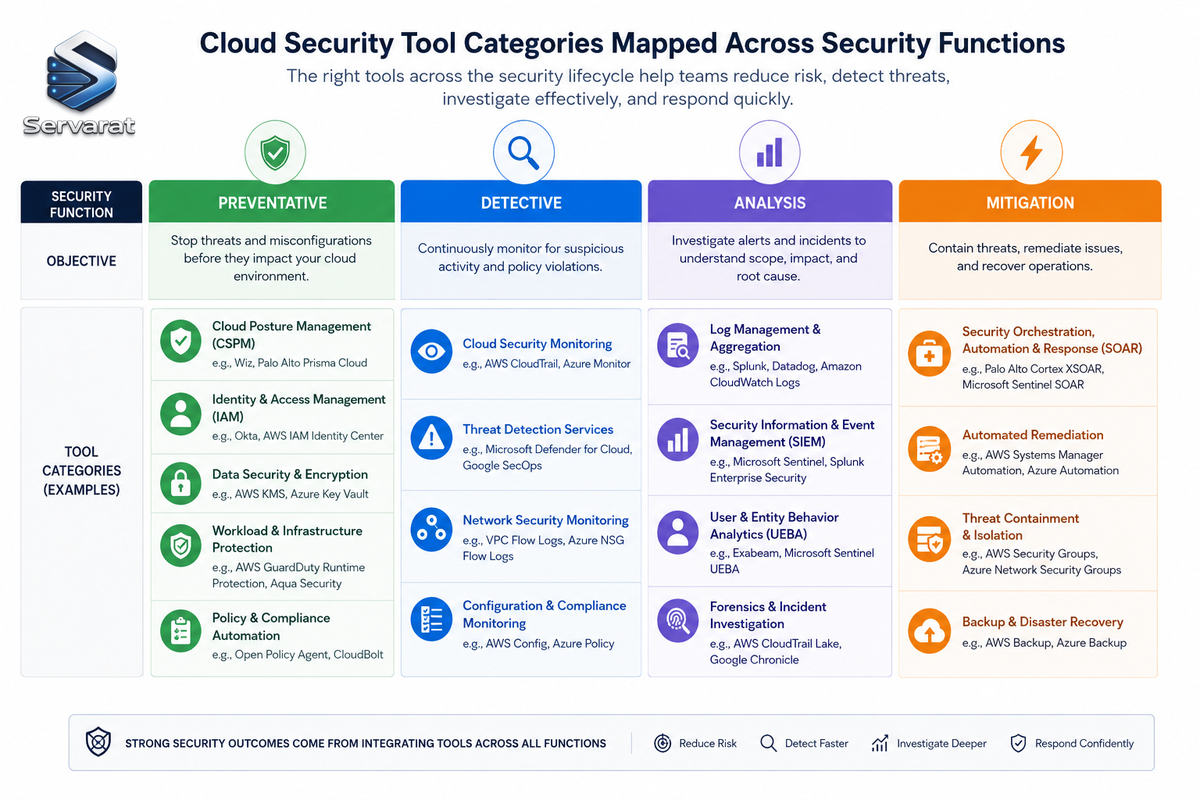
You Don't Have a Tooling Problem. You Have a Mapping Problem.
Most cloud security teams already own too many tools. Yet misconfigured storage, excessive permissions, vulnerable workloads, and exposed Kubernetes services still create exploitable attack paths. The problem isn't a lack of tooling. It's understanding which cloud security tools solve which risks.
The ten tool categories here each address a specific layer of the cloud security stack. Some prevent threats before they materialize. Others detect active incidents. Others analyze risk context. Others accelerate remediation. Knowing which category does which job is the prerequisite to building a stack that actually covers your environment—rather than one that looks complete on paper and leaves predictable gaps.
This article defines each category, maps it to the threats it addresses, and explains when consolidating into a CNAPP produces better coverage than running everything independently.
The Four Functional Groups
Cloud security tools organize by when in the attack lifecycle they operate and what action they enable.
Preventative: Stop threats before they reach production. Enforce access controls, apply least-privilege policies, and block unauthorized cloud service usage before a misconfiguration or exposed credential can be exploited.
Detective: Identify threats already present or actively occurring. Monitor for anomalous behavior, policy violations, and active attack indicators that preventative controls didn't stop.
Analysis: Convert a raw finding into prioritized, actionable risk. Correlate individual misconfigurations into attack paths, classify data sensitivity, and model the blast radius of a breach.
Mitigation: Reduce the impact of identified risks. Automate remediation, enforce access boundaries, and remove the conditions that let an attacker escalate privileges or move laterally.
Most categories overlap these groups. CSPM is primarily preventative but includes detective functions. CDR is primarily detective but feeds mitigation. The mapping below assigns each tool its dominant function while noting secondary ones.
Quick Reference: Tool to Threat
| Tool Category | Primary Function | Dominant Threat Addressed |
|---|---|---|
| CASB | Preventative | Unsanctioned cloud app usage, data exfiltration |
| CDR | Detective | Active cloud intrusions, anomalous API activity |
| CIEM | Preventative | Excess identity permissions, privilege escalation |
| Cloud vulnerability management | Analysis | Unpatched CVEs in cloud workloads |
| CSPM | Analysis + preventative | Cloud resource misconfigurations |
| CWPP | Detective | Workload vulnerabilities, runtime malware |
| DSPM | Analysis | Sensitive data exposure in cloud storage |
| IAM | Preventative | Unauthorized access, credential abuse |
| KSPM | Mitigation | Kubernetes cluster misconfigurations |
| RBAC | Mitigation | Excessive permissions, lateral movement |
1. CASB (Cloud Access Security Broker)
A CASB is a security control point between cloud service users and providers that enforces policies for cloud application access, data movement, and user behavior.
CASBs deploy in two modes:
- API-based: Connect directly to cloud services after authentication to enforce post-access controls—DLP scanning, activity monitoring, anomaly detection.
- Proxy-based: Route all traffic through an inline gateway for real-time access control and content inspection before requests reach the cloud service.
They address two threat classes: sanctioned application misuse (authorized users exfiltrating data within approved apps) and shadow IT (employees accessing unsanctioned services the security team can't monitor).
⚠️ Limitations: Proxy-based CASBs add latency, particularly for latency-sensitive applications. Complex multi-cloud environments require careful configuration to avoid policy gaps at the boundary between the CASB and each provider's native access controls.
2. CDR (Cloud Detection and Response)
CDR monitors cloud control plane activity, API calls, network flows, and workload telemetry for active threat indicators, then provides automated or guided response.
CDR ingests CloudTrail (AWS), Azure Monitor, and GCP Cloud Audit Logs, applying behavioral analytics to detect anomalous patterns: unusual API call sequences, credential use from unexpected geographies, privilege escalation attempts. CISA Advisory AA24-038A (February 2024) documented attackers exploiting API call sequences that individual log entries didn't flag but behavioral baselines caught.
The model is alert-context-response: CDR surfaces an alert, attaches cloud context (which principal, which resource, which API calls preceded it), then triggers an automated playbook or routes to a human analyst.
⚠️ Limitations: CDR effectiveness depends on log completeness. CloudTrail data events (S3 object-level activity, Lambda invocations) aren't enabled by default and must be explicitly configured. Incomplete log coverage means corresponding detection gaps.
3. CIEM (Cloud Infrastructure Entitlement Management)
CIEM continuously discovers, analyzes, and remediates excessive permissions across AWS IAM, Azure AD, and GCP IAM.
CIEM builds a permissions graph showing every principal (human, service account, machine identity) and every permission it holds, then compares effective permissions against permissions actually used over an observation window. The gap is excess entitlement. CIS AWS Foundations Benchmark v3.0 control 1.16 requires least privilege; CIEM is the continuous enforcement mechanism.
⚠️ Limitations: CIEM remediates at the IAM policy layer. It doesn't evaluate network controls or resource-based policies that restrict access independently of IAM. A complete entitlement picture requires correlating CIEM with CSPM network findings.
4. Cloud Vulnerability Management
The continuous process of discovering, prioritizing, and remediating known CVEs in cloud workloads: VMs, containers, serverless functions, managed services.
The core function matches installed package versions against the National Vulnerability Database and vendor advisories, then prioritizes by deployment context. A CVSSv3 9.8 vulnerability on an isolated internal workload with no internet exposure is a lower priority than a CVSSv3 7.2 on an internet-facing container with database access to PII.
CISA's Known Exploited Vulnerabilities (KEV) catalog, updated weekly, is the highest-priority signal—any CVE on it has confirmed active exploitation. BOD 22-01 (November 2021) required federal agencies to remediate KEV-listed CVEs within set timeframes; non-federal orgs use it for emergency patching prioritization.
For Docker specifically, AI-assisted triage tools cut through CVE noise—see OWASP DockSec: AI-Powered Docker Security That Actually Makes Sense for how this works against the "200+ CVE" problem on container images.
⚠️ Limitations: Scheduled-scan tools miss vulnerabilities introduced between intervals. Agentless scanning against block storage snapshots provides more consistent coverage than agent-based tools, which showed 37% workload coverage gaps from unsupported OS versions and agent deployment failures (Orca Security 2023 internal benchmark).
5. CSPM (Cloud Security Posture Management)
CSPM continuously evaluates cloud resource configurations against benchmarks, compliance frameworks, and custom rules, surfacing misconfigurations before exploitation.
CSPM checks resources against CIS Benchmarks for AWS/Azure/GCP, NIST SP 800-53, and compliance frameworks (SOC 2, PCI DSS v4.0, HIPAA, ISO 27001). Each failing check maps to the control it violates, providing audit evidence.
Most commonly surfaced misconfigurations: publicly exposed storage buckets, security groups with overly permissive inbound rules (0.0.0.0/0 on ports beyond 80/443), unencrypted data stores, missing MFA on privileged accounts, disabled audit logging.
⚠️ CSPM without attack path analysis produces a flat list with no priority signal. An environment with 500 findings of varying severity needs attack path correlation to identify which create exploitable chains to sensitive assets versus isolated risks.
⚠️ Limitations: CSPM evaluates configuration state at scan time. It doesn't detect threats originating in application code or runtime behavior that doesn't change cloud resource configurations.
6. CWPP (Cloud Workload Protection Platform)
CWPP scans and monitors workloads—VMs, containers, serverless—for vulnerabilities, malware, exposed secrets, and runtime anomalies. It operates at the workload layer, below the configuration layer CSPM evaluates.
A CWPP scan on a running container reads installed packages, filesystem contents, and runtime process behavior—identifying CVEs in libraries, malware signatures, and anomalous executions indicating active compromise.
Container-specific functions: image scanning before deployment, runtime protection (alerting on process executions deviating from baseline), and drift detection (flagging filesystem changes not present in the original image). NIST SP 800-190 section 3.1 requires container images be scanned before deployment; CWPP image scanning satisfies this.
This is where build-time hardening pays off. The controls covered in 8 Container Security Best Practices for 2026 (minimal base images, non-root execution, image signing) reduce what a CWPP has to flag at runtime in the first place.
⚠️ Limitations: CWPP runtime protection requires a sensor or agent inside or alongside the workload. Agent deployment gaps affected 37% of workloads in agent-based deployments (Orca 2023 benchmark), creating runtime protection gaps.
7. DSPM (Data Security Posture Management)
DSPM discovers sensitive data across cloud storage, classifies it by type, and evaluates the controls protecting it—surfacing cases where sensitive data is exposed by misconfiguration or excessive access.
It addresses the fundamental challenge: you can't protect data you don't know exists. Shadow data (sensitive info in buckets, databases, and object stores outside the security team's awareness) is a common source of unexpected exposure.
DSPM scans S3, Azure Blob, GCP Cloud Storage, RDS, and data warehouses for PII, PHI, financial records, and credentials using pattern matching and ML classifiers. Each finding correlates with the access controls on the resource, producing a combined finding: what sensitive data is present and whether its access configuration creates exposure risk.
Findings map directly to HIPAA Security Rule 164.312(a)(2)(iv), PCI DSS v4.0 requirement 3.5.1, and GDPR Article 32.
⚠️ Limitations: Classification accuracy depends on classifier quality and scan coverage. Custom data formats and proprietary encoding may not be detected without custom rule configuration.
8. IAM (Identity and Access Management)
IAM governs authentication and authorization for every principal in a cloud environment—human users, service accounts, federated identities, machine identities—defining who can access which resources under which conditions.
Cloud IAM is more complex than on-premises identity management: principal types are more varied, permission boundaries span multiple services, and access conditions can combine time of day, source IP, MFA status, and session token age simultaneously.
Privileged Access Management (PAM) extends IAM to high-privilege accounts with just-in-time provisioning, session recording, and approval workflows.
IAM controls most frequently absent in post-breach analysis:
- MFA not enforced on root or administrator accounts
- Access keys older than 90 days with no rotation
- Service accounts with console access enabled
- Cross-account trust relationships granting permissions to invalid external account IDs
CIS AWS Foundations Benchmark v3.0 controls 1.4–1.20 cover IAM hardening: root MFA (1.5), access key rotation (1.14), elimination of unused credentials (1.12).
⚠️ Limitations: IAM governs access at the permission boundary. It doesn't evaluate whether accessed resources are themselves misconfigured. A correctly scoped IAM role granting S3 read access doesn't prevent that bucket's contents from being exposed if the bucket has a public access policy that bypasses IAM entirely.
9. KSPM (Kubernetes Security Posture Management)
KSPM continuously evaluates Kubernetes cluster configurations against benchmarks and custom rules, surfacing misconfigurations that create attack surface.
KSPM checks against CIS Kubernetes Benchmark v1.8 and NIST SP 800-190 section 4.3. Most frequently surfaced misconfigurations: API server accessible from the public internet, anonymous authentication enabled (CIS control 3.2.1), privileged containers without seccomp/AppArmor, pods with hostNetwork or hostPID set to true, and RBAC roles with wildcard permissions on sensitive resources.
CVE-2022-3294 (Kubernetes API server authentication bypass, CVSSv3 8.8) demonstrated that API server misconfiguration can enable direct cluster compromise without credentials. KSPM detects the configuration conditions creating this attack surface before a CVE is disclosed against them.
The Pod Security Admission and admission-control practices in 8 Container Security Best Practices for 2026 are what KSPM continuously audits for drift.
⚠️ Limitations: KSPM evaluates configuration state. It doesn't scan images for CVEs (CWPP) or monitor runtime process behavior (CDR). Complete Kubernetes coverage requires all three.
10. RBAC (Role-Based Access Control)
RBAC enforces access boundaries by assigning permissions to roles rather than individuals, ensuring each principal has access only to what its role requires.
Kubernetes RBAC governs which API operations each service account, user, or group can perform on which resources. ClusterRole and ClusterRoleBinding objects granting cluster-wide permissions to service accounts are among the most common privilege escalation vectors. MITRE ATT&CK for Containers technique T1078.001 (Valid Accounts: Default Accounts) specifically targets service accounts with default or excessive ClusterRole bindings.
⚠️ The RBAC misconfiguration that most frequently creates lateral movement: the system:masters group binding. Any service account bound to system:masters has unrestricted cluster-admin access. Orca's 2025 State of Cloud Security Report found 93% of organizations have at least one privileged Kubernetes service account.
Effective RBAC follows least privilege per NIST SP 800-53 control AC-6. Regular permission audits using KSPM tooling enforce this continuously rather than at point-in-time intervals.
⚠️ Limitations: RBAC enforces permissions at the Kubernetes API layer. It doesn't control network traffic between pods (network policy) or restrict syscalls (seccomp/AppArmor). Complete Kubernetes access control requires RBAC, network policies, and runtime security profiles together.
Non-Negotiable Features
Any cloud security tool evaluated for production must satisfy four baseline requirements regardless of category.
Full asset visibility through API integrations. A tool that discovers assets by network scanning misses resources with no public IP. Tools must integrate with AWS/Azure/GCP APIs directly to enumerate everything—serverless functions, managed databases, object storage never reachable from the network.
Context-aware risk prioritization. A finding without deployment context isn't actionable. The tool must correlate vulnerability severity with internet exposure, data sensitivity, IAM permissions, and proximity to sensitive assets. A CVSSv3 9.8 on an air-gapped dev instance is not the same priority as a CVSSv3 7.2 on an internet-facing production server with PII database access.
Automated remediation workflows. Manual remediation at scale isn't sustainable. The tool must integrate with ticketing (Jira, ServiceNow, PagerDuty) and IaC pipelines to route findings to the responsible team with the specific remediation step included, not just the finding description.
Compliance framework mapping. Every finding must map to the specific control number in the applicable framework (CIS, NIST SP 800-53, PCI DSS, HIPAA) so compliance reporting doesn't require manual translation between findings and audit evidence.
Consolidating with a CNAPP
A Cloud Native Application Protection Platform (CNAPP) consolidates CSPM, CWPP, CIEM, DSPM, KSPM, vulnerability management, and CDR into a single platform with a unified data model.
Security teams often build franken-stacks where each tool generates alerts in a separate dashboard and analysts manually connect findings. A CNAPP replaces that with a shared asset graph and unified risk context.
The value is correlation. A storage bucket misconfiguration, an overprivileged role, missing IMDSv2 enforcement on an EC2 instance, and an unauthenticated endpoint are four separate findings in a siloed stack—and a single critical attack path in a CNAPP.
CNAPPs with integrated SCA can generate a Software Bill of Materials (SBOM) across the full workload inventory, satisfying Executive Order 14028 requirements without a separate SCA deployment.
⚠️ The consolidation limit: CNAPPs covering all categories at shallow depth don't replace specialized tools that cover one category at depth. A CNAPP's CWPP module may not match the runtime behavioral detection of a dedicated workload security agent. The correct architecture depends on your threat model and compliance requirements.
References
- Orca Security: Cloud Security Tools — 10 Types Explained (Source)
- CIS Benchmarks (AWS, Azure, GCP, Kubernetes)
- NIST SP 800-190: Application Container Security Guide
- NIST SP 800-53: Security and Privacy Controls
- CISA Known Exploited Vulnerabilities Catalog
- CISA Binding Operational Directive 22-01
- CISA Advisory AA24-038A
- MITRE ATT&CK for Containers
- CIS AWS Foundations Benchmark
- Executive Order 14028: Improving the Nation's Cybersecurity