Automating CIS Kubernetes Benchmark Compliance: The Open-Source Toolset

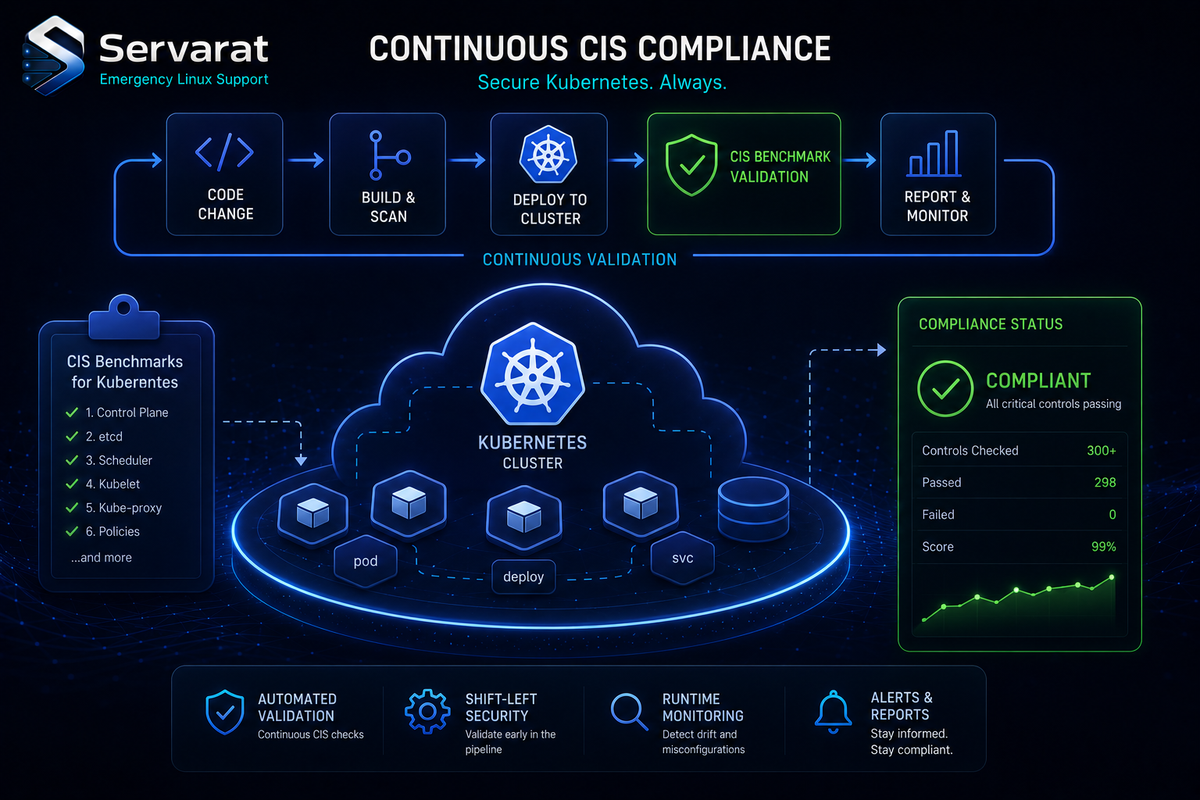
Manual compliance audits don't survive contact with Kubernetes. Pods live and die in seconds, a snapshot is stale the moment you take it, and a single kubectl patch applied during a 3 a.m. incident silently drifts a cluster off its CIS baseline until the next scheduled audit weeks later finds it. The fix is policy-driven checks that run continuously across the pipeline, from build to runtime. This walks through the CIS Kubernetes Benchmark, the recurring compliance pain points, and the four open-source tools that actually automate the work, including where each one stops.
The CIS Kubernetes Benchmark, Briefly
The CIS Kubernetes Benchmark is a consensus-based hardening guide from the Center for Internet Security, with prescriptive controls across the control plane, worker nodes, etcd, policies, and network config. It's versioned against Kubernetes releases, and it splits into two profile levels:
| Attribute | Level 1 | Level 2 |
|---|---|---|
| Target | All deployments | Sensitive / regulated data |
| Posture | Basic hardening, broad applicability | Advanced hardening, defense-in-depth |
| Operational impact | Minimal disruption | May restrict functionality or need extra config |
| Example controls | Disable anonymous auth; enable audit logging | Enforce Pod Security Admission (restricted); encrypt etcd at rest |
| Compliance mapping | NIST SP 800-53, SOC 2 | PCI-DSS, HIPAA, FedRAMP |
The sane rollout order: enforce all Level 1 first, get to a passing baseline, then layer Level 2 onto the namespaces and clusters that actually process sensitive workloads. Trying to hit hundreds of controls at once with no baseline is how teams stall out. Level 2 carries real operational cost, so scope it to where the data sensitivity justifies it rather than blanket-applying.
The Recurring Pain Points
The difficulty compounds as you scale, and it's the same handful of problems every time:
Configuration drift. Rapid scaling widens the margin for error. A missed setting during a node-pool expansion, or a manual patch during an incident, drifts a cluster off baseline, and the deviations accumulate. NIST SP 800-190 names container-platform misconfiguration as a primary risk category. Without continuous validation, you find drift at the next audit, not when it happens.
Vulnerable images post-deployment. Even a mature CI/CD pipeline ships containers on base images that were clean at build time and became vulnerable days later as new CVEs dropped. Scanning only at build is a false sense of security. ⚠️ This is the one teams underestimate most: an image's risk profile changes while it sits running and untouched, so a build-time-only gate guarantees blind spots. You need assessment against running workloads, not just the pipeline.
Over-permissive RBAC. RBAC is one of the strongest isolation mechanisms in Kubernetes and one of the most commonly botched. Handing cluster-admin to a service account to "unblock" a deploy bypasses namespace isolation entirely, and when that over-permissioned pod gets compromised, the attacker inherits the permissions. Blast radius jumps from one workload to the whole cluster. CISA's Kubernetes Hardening Guide calls out least-privilege RBAC as critical for exactly this reason.
Alert fatigue. Manage all this with a pile of disconnected tools and every finding, a drifted API server setting, an unpatched image, a bad RBAC role, arrives at the same severity with no shared context. Teams burn cycles triaging instead of remediating, and the security-engineering relationship erodes.
The Four Tools That Do the Work
No single open-source tool covers the whole lifecycle, config scanning to policy enforcement to runtime detection. Each owns a slice. Understanding the slices is what stops you from building a "franken-stack" of overlapping alerts with blind spots between them.
kube-bench — point-in-time assessment
Aqua Security's kube-bench inspects control plane, worker nodes, etcd, and policies against the CIS Benchmark definitions. It runs as a job inside the cluster and emits a pass/fail per control. It's the right tool for a point-in-time assessment and slots cleanly into CI/CD as a gate.
⚠️ Its limit is scope: it checks configuration, it doesn't enforce policy or watch runtime. kube-bench tells you where you stand today; it does nothing to stop tomorrow's drift. Treat it as the measurement, not the control.
OPA / Gatekeeper — admission-time enforcement
Open Policy Agent, usually via the Gatekeeper admission controller, evaluates requests against custom rules before resources are admitted, so non-compliant config never enters the cluster in the first place. Policies are written in Rego, which gives fine-grained control.
⚠️ The tradeoff is Rego itself: writing and maintaining policies at scale is a real skill investment, and a team without dedicated expertise ends up with a handful of copy-pasted policies they don't fully understand. Budget for the learning curve, or you'll under-use the most powerful tool in the set. This is the enforcement layer, though, and it's what makes "shift left" actually mean something.
Falco — runtime threat detection
Falco watches kernel syscalls in real time and fires on anomalous behavior: unexpected privilege escalation, a shell spawned inside a container, sensitive file access. It fills the gap the config scanners can't touch, what happens after deployment.
⚠️ Falco generates high event volume and needs tuning plus a correlation layer to be actionable, otherwise it becomes its own alert-fatigue source. Out of the box it's noisy; the value comes after you've tuned the rules to your workloads. This is the only tool of the four that sees runtime behavior, so the tuning effort is worth it, but plan for it.
Kubescape — posture management, shift-left
Kubescape scans manifests, Helm charts, and RBAC against CIS Benchmarks and NSA/CISA hardening guidance, assigns risk scores, and is especially good at checking infrastructure-as-code artifacts before deployment. It's the shift-left posture tool: catch the misconfiguration in the manifest, not in the running cluster.
How they fit together
The honest architecture, if you're going open-source:
- Kubescape in the pipeline, scanning manifests/Helm/IaC before anything deploys (shift-left posture).
- OPA/Gatekeeper at the admission controller, blocking non-compliant resources from entering (enforcement).
- kube-bench on a schedule, measuring the live cluster against CIS (point-in-time assessment/drift detection).
- Falco running continuously, catching what got through and what happens at runtime (runtime detection).
That's build → admit → assess → watch, each stage owned by the tool that's actually good at it. The gap the vendors correctly identify is that these four produce four dashboards with four data models and no shared context, so a vulnerable image running as cluster-admin and exposed to the internet shows up as three unrelated alerts instead of one attack path. That correlation problem is real, and it's the pitch for commercial CNAPP platforms. Whether that's worth a platform spend or whether you'd rather correlate in your own SIEM/observability stack is a genuine build-vs-buy call, not a foregone conclusion, especially at smaller cluster counts where the franken-stack is manageable.
The Compliance-Isn't-Security Point
Worth stating plainly, because it's the trap: passing the CIS Benchmark means your configuration matches a baseline. It says nothing about a runtime compromise, a zero-day in a running image, or an attacker already inside with valid credentials. Compliance is a subset of security, not a substitute, which is exactly why the toolset above spans admission and runtime rather than stopping at a config scan. A cluster can be 100% CIS-compliant and actively compromised at the same time.
This is the same reasoning that runs through building security into the whole pipeline rather than bolting it on, which I got into in the container security best practices and the broader cloud security standards for compliance. If you're evaluating tooling rather than assembling it yourself, the same category-fit thinking from the container security tools buyer's guide applies here: match the tool to the slice of the lifecycle you actually have a gap in, don't buy overlap. And on the image side specifically, OWASP DockSec covers the build-time hardening that pairs with the runtime scanning this article is about.
Bottom Line
CIS Kubernetes compliance automates cleanly if you accept that it takes four tools, not one: Kubescape to shift left, OPA/Gatekeeper to enforce at admission, kube-bench to measure drift, Falco to watch runtime. Each has a real gap, kube-bench doesn't enforce, OPA needs Rego skill, Falco needs tuning, Kubescape stops at posture, and knowing those gaps is what lets you assemble them without blind spots. Start with Level 1, gate the pipeline, and remember that a passing benchmark is the floor, not the finish line.