What to Look for in Container Security Tools: A Buyer's Guide

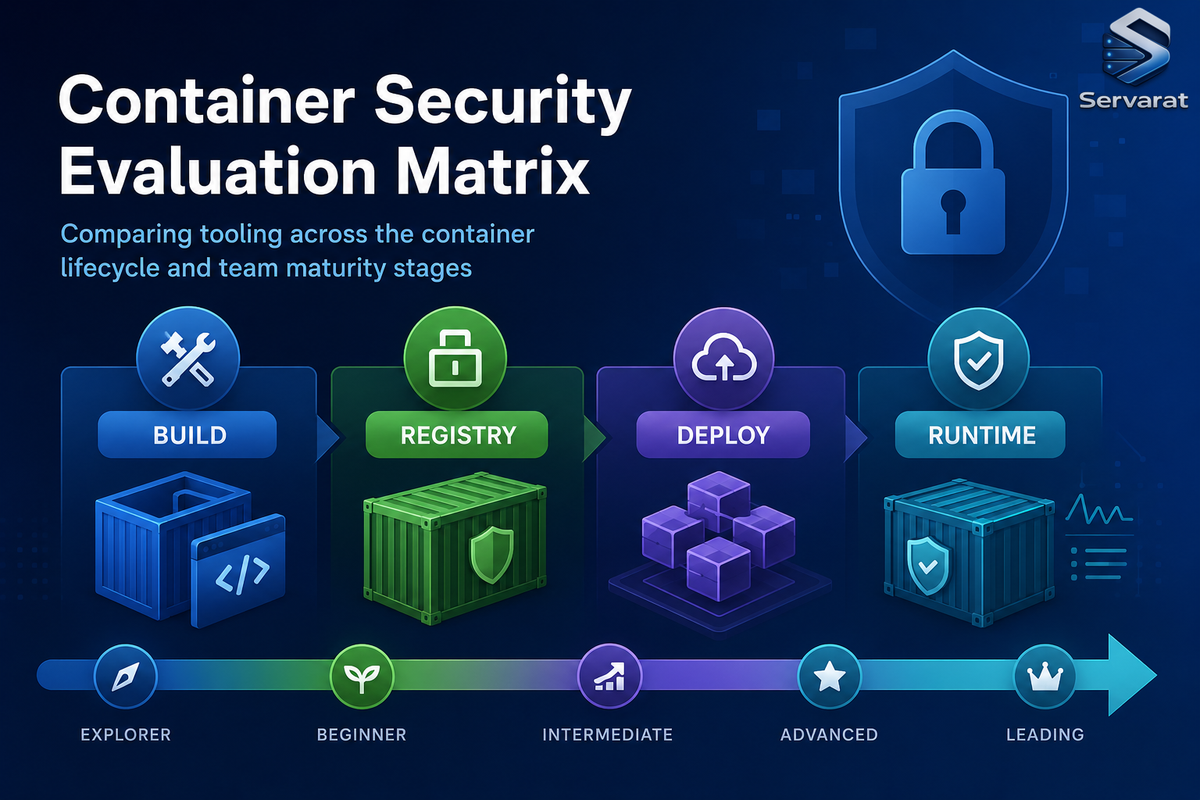
Why Container Security Tooling Needs Its Own Evaluation Framework
Container adoption keeps outpacing security maturity in most organizations. Traditional endpoint protection was never designed for ephemeral, highly dynamic containerized environments, and it often fails to provide the visibility these workloads demand—agents assume persistent endpoints with stable operating systems, and containers that live for seconds break that assumption.
Evaluating container security tools requires a structured framework that accounts for the full software lifecycle, from build through runtime. This guide gives you a vendor-neutral buyer's matrix, maturity-based recommendations, and clear criteria for what separates modern platforms from legacy approaches.
If you're earlier in the journey and still defining your baseline controls, start with 8 Container Security Best Practices for 2026—this guide assumes you already know what to secure and are now choosing how.
Primary Evaluation Criteria
Before comparing specific products, anchor your evaluation on five criteria that consistently separate tools that work at scale from tools that generate noise:
- Lifecycle coverage: Build, registry, deploy, and runtime security in a single platform
- Agentless-first architecture: Full visibility without agent deployment friction
- Context-aware prioritization: Risk scoring based on real exploitability, not raw CVSS alone
- CI/CD integration: Security embedded in developer workflows, not bolted on
- Unified data model: Consolidated telemetry that reduces alert noise and clarifies remediation paths
Securing the Full Lifecycle
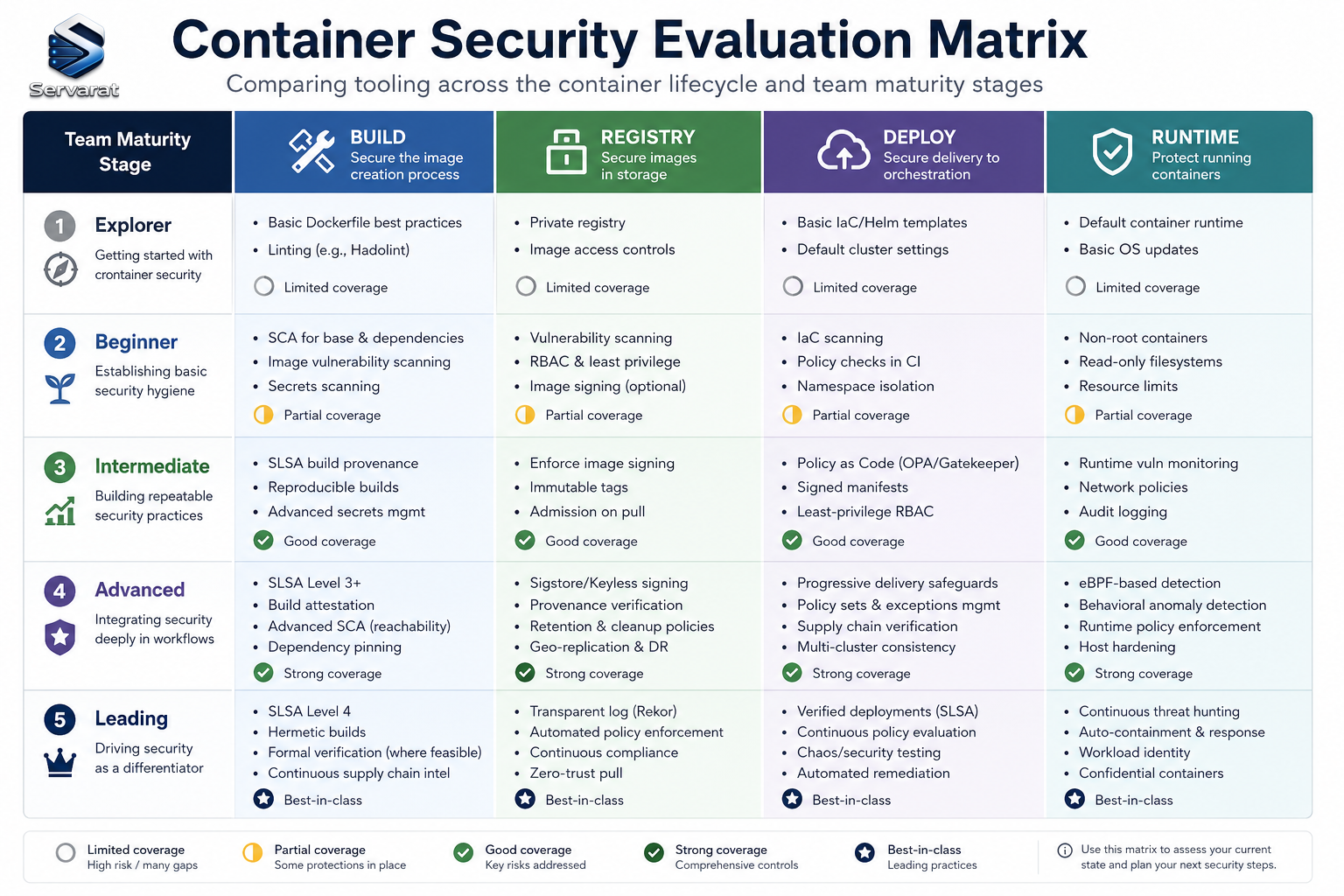
Risk in containerized environments doesn't sit in one place. It travels with the software—originating in a base image pulled during build, amplified by a misconfigured Kubernetes manifest at deployment, and ultimately exploitable at runtime if left unaddressed. A sound methodology maps tool categories to each phase so no gap exists between what you scan for and what actually runs in production.
| Lifecycle Phase | Security Focus | Tool Category |
|---|---|---|
| Build | Vulnerable packages, malware in base images, hardcoded secrets | Image scanning, SBOM generation |
| Registry | Trusted image enforcement, signature verification | Registry scanning, provenance validation |
| Deploy | Kubernetes misconfigurations, excessive RBAC, network policies | Admission controllers, configuration/posture management |
| Runtime | Zero-day exploits, container escapes, anomalous network behavior | Runtime threat detection, behavioral monitoring |
Image Scanning and SBOM
Baseline visibility starts with scanning images for known vulnerabilities before they reach a cluster. Generating a Software Bill of Materials is equally important—it maps every transitive dependency in your open-source components, revealing risks buried several layers deep in the supply chain. Without this foundation, you're making deployment decisions with incomplete information. (For how AI-assisted triage cuts through the resulting CVE noise on Docker images specifically, see OWASP DockSec: AI-Powered Docker Security That Actually Makes Sense.)
Configuration and Posture Management
Misconfigurations in Kubernetes manifests, Helm charts, and RBAC policies account for a significant share of container incidents. Posture management tools continuously audit cluster configurations against benchmarks like the CIS Kubernetes Benchmark, flagging overly permissive service accounts, missing network policies, and publicly exposed services before an attacker can use them.
Runtime Threat Detection
Runtime security is the last line of defense. These tools detect behavioral indicators of exploitation—zero-day exploits, unexpected network connections, container escape attempts—that bypass every shift-left control you've put in place. When a previously unknown vulnerability gets weaponized in production, runtime visibility decides whether your team catches it quickly or finds it during a post-incident investigation.
The Buyer's Matrix: Legacy vs. Modern
The gap between legacy and modern approaches is significant across every dimension that matters.
| Feature | Why It Matters | Legacy Approach | Modern Approach |
|---|---|---|---|
| Deployment model | Coverage speed and operational burden | Agent per node/container; manual rollout | Agentless scanning with API-level integration |
| Risk prioritization | Separates actionable findings from noise | Raw CVSS scores, flat severity lists | Context-aware scoring using attack path analysis |
| Kubernetes posture | Prevents misconfig-driven breaches | Periodic manual audits, CIS checklists | Continuous automated posture assessment |
| SBOM & supply chain | Tracks transitive dependency risk | Ad-hoc image scanning at build | Continuous SBOM across registries and runtime |
| Runtime detection | Catches threats bypassing pre-deploy controls | Repurposed EDR agents, high false positives | Purpose-built behavioral detection for ephemeral workloads |
| CI/CD integration | Embeds security without slowing releases | Separate scanning step, manual tickets | Native integration with Git, Jira, pipeline tools |
| Multi-cloud support | Unifies visibility across providers | Separate provider-native tools per cloud | Centralized visibility across AWS, Azure, GCP |
| Compliance mapping | Reduces audit prep time | Manual evidence collection per framework | Automated mapping to CIS, PCI-DSS, NIST, SOC 2 |
Agentless vs. Agent-Based Overhead
The traditional approach deploys a software agent onto every node and sometimes into every container. In practice this creates friction: agents consume CPU and memory, require ongoing maintenance and version management, and introduce compatibility risk with host operating systems. In ephemeral environments where containers may live for seconds, agent deployment creates coverage gaps that are invisible to the security team.
An agentless-first architecture reads workload data at the block-storage and API level, providing full visibility into images and running workloads without touching the runtime. No performance degradation, no deployment coordination with DevOps, no coverage gaps in short-lived containers. For organizations running thousands of containers across multiple clusters, the difference in operational overhead is substantial.
⚠️ Agentless isn't a complete substitute for everything an in-line agent does. Agentless excels at visibility, vulnerability assessment, and posture; some real-time blocking and syscall-level enforcement still benefit from a runtime sensor. The strongest programs use agentless as the default coverage layer and add targeted runtime sensors where active prevention genuinely matters—not blanket agents everywhere.
Context-Aware Risk Prioritization
A raw CVSS score tells you how severe a vulnerability could be in theory. It tells you nothing about whether it's exploitable in your specific environment. Context-aware prioritization maps each finding against the conditions that determine real-world risk:
- Network context: Is the vulnerable container internet-exposed, or isolated behind layers of network controls?
- Identity context: Does the workload have excessive IAM permissions an attacker could use for lateral movement?
- Data context: Is the container connected to sensitive data stores, secrets, or encryption keys that raise the blast radius?
Attack path analysis combines these into a single exploitability assessment, letting teams focus on findings that represent genuine business risk rather than chasing thousands of theoretical vulnerabilities. This is the same KEV-over-CVSS prioritization logic that mature vulnerability programs already apply—reachability beats raw severity.
DevSecOps and CI/CD Integration
Security tools that live outside the developer workflow don't get used consistently. Effective tools integrate directly into Git repositories, CI/CD pipelines, and ticketing systems like Jira, so findings surface as part of the natural shift-left process. This enables remediation guidance at the pull-request level—catching vulnerable base images or misconfigured Dockerfiles before they merge—without adding a manual gate that slows deployment velocity.
Choosing Tools by Team Maturity
Not every organization needs the same tooling on day one. The right solution depends on where your team sits on the maturity curve.
| Maturity Stage | Primary Risk | Recommended Tooling |
|---|---|---|
| Early (1-2 clusters, small team) | Unknown vulnerabilities in base images; no inventory of running containers | Image scanning, basic SBOM, CIS benchmark checks |
| Growing (multiple clusters, dedicated DevSecOps) | Config drift, inconsistent policies, rising alert volume | Kubernetes posture management, CI/CD-integrated scanning, initial runtime monitoring |
| Mature (multi-cloud, enterprise scale) | Tool sprawl, alert fatigue, fragmented compliance, slow IR | Full CNAPP consolidation with unified risk scoring, automated compliance mapping, attack path analysis |
The pattern is clear: as container footprints grow, the cost of maintaining disconnected point tools rises faster than the cost of consolidating onto a single platform. Teams that delay consolidation typically find themselves managing five or more separate tools with overlapping but inconsistent coverage.
⚠️ Don't over-buy for your stage. A two-cluster team that purchases an enterprise CNAPP usually under-uses 80% of it while still paying for the complexity. Buy for the stage you're in plus one step ahead—not for the org you imagine becoming.
Overcoming Alert Fatigue
Teams running containers across multiple clusters with separate tools for image scanning, runtime monitoring, and compliance know the problem well. Each tool generates its own alert stream with its own severity scale, format, and remediation guidance. The result is thousands of disconnected vulnerability alerts with no clear path to root cause. Ownership is unclear, prioritization is inconsistent, and critical findings get buried in noise.
The structural fix:
- Consolidate telemetry into a unified data model that normalizes findings from image scanning, configuration audits, and runtime detection into a single view.
- Apply context-aware scoring so every alert carries information about network exposure, identity permissions, and data sensitivity.
- Map attack paths automatically to show how an attacker could chain individual findings into a complete compromise—making it obvious which issues to fix first.
- Assign clear remediation ownership by mapping findings to the specific team, repository, or pipeline responsible for the affected workload.
This replaces the "wall of alerts" with a prioritized, actionable queue. Teams spend their time fixing real risks instead of triaging noise.
How This Fits the Broader Cloud Security Stack
Container security tools don't operate in isolation—they're one slice of a larger cloud security toolchain that includes posture management (CSPM), workload protection (CWPP), entitlement management (CIEM), and Kubernetes posture (KSPM). Understanding how these categories fit together helps you avoid buying overlapping tools that each solve part of the same problem. The acronym soup and where each tool fits is worth mapping before you commit budget.
Conclusion
Evaluating container security tools comes down to a few honest questions. Does it cover the full lifecycle, or just the build phase? Does it give you visibility without an agent-deployment project? Does it prioritize by real exploitability, or hand you a flat list of CVSS scores? Does it live inside the developer workflow, or outside it where it'll be ignored? And does it consolidate findings into one model, or add another alert stream to the pile?
Match the answer to your team's maturity, resist the urge to over-buy, and prefer tools that reduce the number of dashboards your team has to watch rather than adding to them. The best container security tool is the one your team will actually operate consistently—not the one with the longest feature list.
References
- Orca Security: What to Look for in Container Security Tools (Source)
- CIS Kubernetes Benchmark
- NIST SP 800-190: Application Container Security Guide
- CISA Known Exploited Vulnerabilities Catalog
- OWASP: Software Component Verification Standard (SCVS)
- CNCF: Cloud Native Security Whitepaper
- SLSA: Supply-chain Levels for Software Artifacts