Top 10 Cloud Security Standards for Compliance

Why Standards Exist, and Why You Run Several at Once
Cloud security standards translate legal, contractual, and industry expectations into auditable controls for identity, data protection, logging, and resilience. They give security, legal, and engineering teams a shared language for controls, evidence, and assurance.
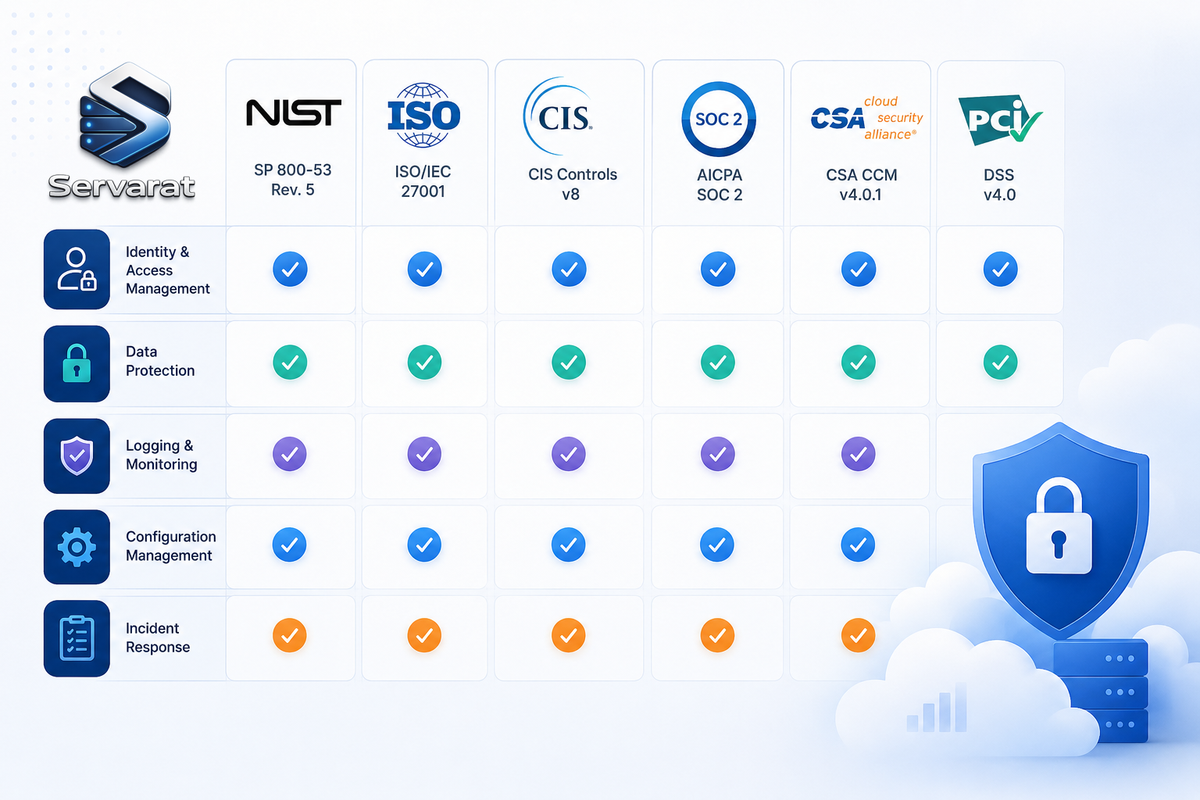
The thing nobody tells you starting out: you rarely adopt one framework in isolation. Most enterprises map their cloud program to several baselines at once—ISO for management systems, NIST for detailed control catalogs, CIS for technical hardening, and sector rules like PCI DSS or HIPAA—then evidence control satisfaction with scans, policies, and change records.
The payoff of doing this well is leverage. If a control maps to multiple frameworks, one well-scoped remediation improves several compliance narratives simultaneously. A single IAM fix can close findings for SOC 2 access control criteria, PCI DSS logical access requirements, and ISO 27001 access management themes at the same time. That overlap is the whole game—it's why a control matrix beats chasing each audit separately.
Standards also improve incident readiness. When logging and retention already meet a defined baseline, forensic teams don't waste time proving artifacts should exist. When access reviews are routine, a stolen-credential investigation starts with accurate entitlement data instead of a scramble.
What a Standard Actually Is (and Isn't)
Cloud security standards are documented expectations for how you protect data, identities, networks, and operations. Some are certifiable management systems. Others are control catalogs you assess against. Some are laws.
⚠️ A standard is not a tool. Tools implement checks derived from standards. And there's a critical distinction worth internalizing early: "compliant on a point-in-time scan" is not the same as "operating a control effectively across changes." Cloud configurations drift daily. Sustainable programs tie scans to change management, require peer review for exceptions, and put metrics in front of leadership monthly—not just before the annual audit.
The 10 Standards
Treat this as a reading order, not a certification plan. Your counsel and compliance office decide which are actually in scope for your contracts and jurisdictions.
1. ISO/IEC 27001 and 27002
ISO/IEC 27001 specifies requirements for an information security management system (ISMS). ISO/IEC 27002 provides implementation guidance for controls like access management, cryptography, and supplier relationships. Certification involves accredited auditors reviewing evidence of operating effectiveness—not just policy PDFs.
For cloud, align your ISMS scope to specific services and regions, and keep cloud subprocessors in your register with their attestations reviewed on a schedule. Annex A controls in 27001:2022 stay familiar, but your evidence has to reflect cloud reality: infrastructure-as-code repositories, CI/CD change records, and API-based access reviews rather than traditional server inventories.
2. NIST Security Controls
NIST publishes Special Publications including SP 800-53 Rev. 5 (security and privacy controls) and SP 800-207 (zero trust architecture). Federal systems and many commercial enterprises use the 800-53 control families as a structured cloud baseline—MFA enforcement, centralized logging, key rotation, and configuration guardrails in IaC.
NIST also publishes the Cybersecurity Framework (CSF) 2.0 for outcomes-focused program management. Many enterprises map the CSF functions—Govern, Identify, Protect, Detect, Respond, Recover—to 800-53 controls for cloud services.
3. Cloud Security Alliance (CSA)
The CSA publishes the Cloud Controls Matrix (CCM) and the Consensus Assessment Initiative Questionnaire (CAIQ). CSA STAR supports provider transparency through self-assessment, third-party audit, and continuous monitoring.
You'll use CSA artifacts during vendor evaluations. ⚠️ When you do, ask vendors how they handle control regressions between annual assessments—STAR continuous monitoring rewards providers who expose ongoing telemetry instead of a point-in-time questionnaire that's stale the day after it's signed.
4. CIS Benchmarks
CIS Benchmarks provide prescriptive configuration recommendations for AWS, Azure, GCP, Kubernetes, and common operating systems. Each recommendation carries a severity and rationale, and posture tools or CIS-CAT scans measure compliance.
⚠️ Benchmarks are consensus hardening guidance, not laws. Treat them as living documents and update your checks when new versions drop. Your risk appetite may demand stricter settings than Level 1, especially for regulated data—Level 1 is a floor, not a target.
5. FedRAMP
FedRAMP standardizes security assessment for cloud services used by US federal agencies, with authorization at moderate or high baselines plus continuous monitoring obligations. Commercial vendors selling to the federal market pursue it; customers outside government sometimes reference FedRAMP packages as evidence of rigor.
Review authorization packages when your workloads inherit shared-responsibility tasks the vendor doesn't perform—customer-managed encryption keys, VPC networking choices, and the like.
6. SOC 2
SOC 2 reports cover trust service criteria for security, availability, processing integrity, confidentiality, and privacy. Cloud-native companies rely on SOC 2 Type II reports for recurring assurance over a review period.
If you're consuming a SOC 2 report, read the scope of services, the complementary user entity controls (the things you're responsible for), and any auditor-noted exceptions. If you're the service organization, align controls to the common criteria—CC6 for logical access, CC7 for monitoring—and map ticket and change data to evidence requests early to avoid audit-season fire drills.
7. HIPAA and HITECH
HIPAA and HITECH set US requirements for protected health information. Covered entities and business associates must implement administrative, physical, and technical safeguards for ePHI: business associate agreements with cloud vendors, encryption of PHI in transit and at rest, and audit logs for access to PHI systems.
⚠️ OCR enforcement cases frequently cite missing safeguards or inadequate risk analysis—not just a single misconfiguration. Document which cloud services process ePHI, whether data crosses regions, and how backups are encrypted. The missing risk analysis is what turns one incident into a finding.
8. PCI DSS
PCI DSS applies when cardholder data is stored, processed, or transmitted. Cloud environments need network segmentation evidence, secure configuration of payment components, and strict access control to anything touching card data.
The smartest move is scope reduction: don't store card data when payment processors can handle tokens instead. ⚠️ Document card data flows across microservices carefully—container sprawl and message queues quietly broaden PCI scope when PAN fragments land in logs or traces without masking. The scope you don't realize you have is the scope that fails the assessment.
9. GDPR
GDPR applies to organizations processing personal data of individuals in the EU. Its principles—lawfulness, purpose limitation, data minimization, integrity, accountability—translate into cloud concerns like data residency, data processing agreements (DPAs), subprocessor registers, breach notification timelines, and records of processing activities.
Privacy-by-design features such as field-level encryption and tokenization reduce data-subject risk—but only when paired with correct key management. Encryption with mismanaged keys is theater.
10. Cloud Service Provider Frameworks
AWS, Azure, and Google Cloud publish compliance documentation, security reference architectures, and recommended controls aligned with ISO, SOC, PCI, and FedRAMP. Use this provider-specific guidance to interpret shared responsibility correctly.
⚠️ Provider compliance pages list which services fall under which attestations, and misreading that scope is a classic source of false confidence—teams assume encryption defaults they never actually enabled. Trace every provider setting back to your own control matrix so an auditor can follow the line from policy to configuration.
Putting Standards Into Practice
Define scope and evidence sources first
Start with scope: which systems, accounts, and data classes fall under which frameworks. Then map controls to owners and evidence sources, and automate evidence collection wherever you can—configuration snapshots, IAM reports, vulnerability scan results, and change tickets.
Avoid checkbox theater
Controls that look good on paper but fail in production are the ones that bite during an incident:
- Overly broad IAM roles that pass a policy review but grant far more than needed
- Logging buckets without retention locks (an attacker or a mistake deletes the evidence)
- Exception queues without expiry dates, so "temporary" exceptions live forever
⚠️ Integrate vulnerability management with compliance evidence: your patch SLAs should reference the same criticality model you use for risk acceptance and exception approval. When those two systems disagree, you get findings that are "accepted" in one place and "overdue" in another.
Establish a governance cadence
Quarterly control reviews for high-risk services, annual reviews for stable platforms, and ad-hoc reviews triggered by architecture changes. The architecture-change trigger is the one teams forget—it's exactly when drift and scope creep happen.
The mapping that ties it together
Understanding which tools enforce which standards is its own problem—CSPM encodes CIS and benchmark checks, DSPM maps to HIPAA/PCI/GDPR data obligations, KSPM to CIS Kubernetes. Cloud Security Tools: 10 Types Explained for Teams Mapping each obligation to a provider service, an internal owner, and an evidence source before you fund audit prep is what separates a program from a scramble.
Conclusion
The most relevant mix of standards depends on your sector, geography, and customer contracts. Technical baselines like CIS pair with management systems like ISO 27001 and regulatory rules like GDPR or HIPAA. Implementation comes down to mapping controls to owners, automating evidence where possible, and revisiting scope when architecture changes.
Continuous monitoring matters as much as the annual audit, because cloud configurations drift daily without automation. The teams that stay compliant aren't the ones with the thickest binder—they're the ones who wired evidence collection into the systems that change, so the audit is a report on reality rather than a performance staged once a year.
References
- Orca Security: Top 10 Cloud Security Standards for Compliance (Source)
- ISO/IEC 27001 Information Security Management
- NIST SP 800-53 Rev. 5: Security and Privacy Controls
- NIST Cybersecurity Framework 2.0
- Cloud Security Alliance: STAR Registry
- CIS Benchmarks
- FedRAMP
- AICPA: SOC 2
- HHS: HIPAA Security Rule
- PCI Security Standards Council: PCI DSS
- GDPR Official Text