WordPress 7.0.3: A Pre-Auth Login XSS That Chains to RCE, and Why It's Not wp2shell

Three weeks after wp2shell, WordPress has shipped another security release with an RCE-capable headline bug, and the coverage is already blurring the two. Get the distinction straight, because it changes your urgency: CVE-2026-64638 in WordPress 7.0.3 is a pre-authentication reflected XSS on the login page that can chain to PHP code execution, but unlike wp2shell it is not mass-exploitable. It needs a logged-in administrator to click an attacker's link. That makes it a targeted-attack problem, not a scanner-sprays-the-internet problem. Patch it (auto-updates likely already did), but calibrate the response correctly rather than treating it like the last one.
This is a different bug from the wp2shell unauthenticated RCE I covered in 7.0.2. That one (CVE-2026-63030) was a true no-interaction, anyone-can-run-it RCE via the REST batch endpoint. This one (CVE-2026-64638) requires social engineering an admin. Same "AI-discovered WordPress core RCE" news cycle, genuinely different severity profiles.
What It Is, and the Honest Severity Read
CVE-2026-64638, CVSS 8.9, affects every WordPress version and was patched August 6 in 7.0.3, backported through the 4.7 branch. pwn.ai found it, calls the chain XSS2Shell, and their autonomous system discovered and reproduced it after being pointed at Paulos Yibelo's 2022 Same-Origin Method Execution (SOME) research.
⚠️ Here's the calibration the pwn.ai writeup underplays and WordPress's advisory stresses. This is a reflected XSS, not stored. Reflected XSS only fires in the browser of whoever clicks the crafted link; it doesn't self-spread the way stored XSS does. So the attack is a targeted send: the attacker needs one specific person, on your specific site, to click one specific URL. And that person has to be an Administrator for the payload to do anything useful, if a logged-out visitor or a subscriber clicks it, nothing meaningful happens. WordPress's advisory puts it plainly: escalation to RCE "requires successful social engineering plus explicit victim interaction."
Patchstack's Oliver Sild, tracking exploitation, was blunt that this is unlikely to draw the attention wp2shell did, precisely because the social-engineering requirement makes it not mass-exploitable. That's the right frame. It's a real, serious bug for a targeted attacker who knows your admin's email and can get them to click, and a low-probability event for a random site behind auto-updates. Both things are true.
How the Chain Works (Worth Understanding, Because It's Clever)
The mechanics are a genuinely elegant parser-differential, and understanding them tells you why hardening alone won't save you:
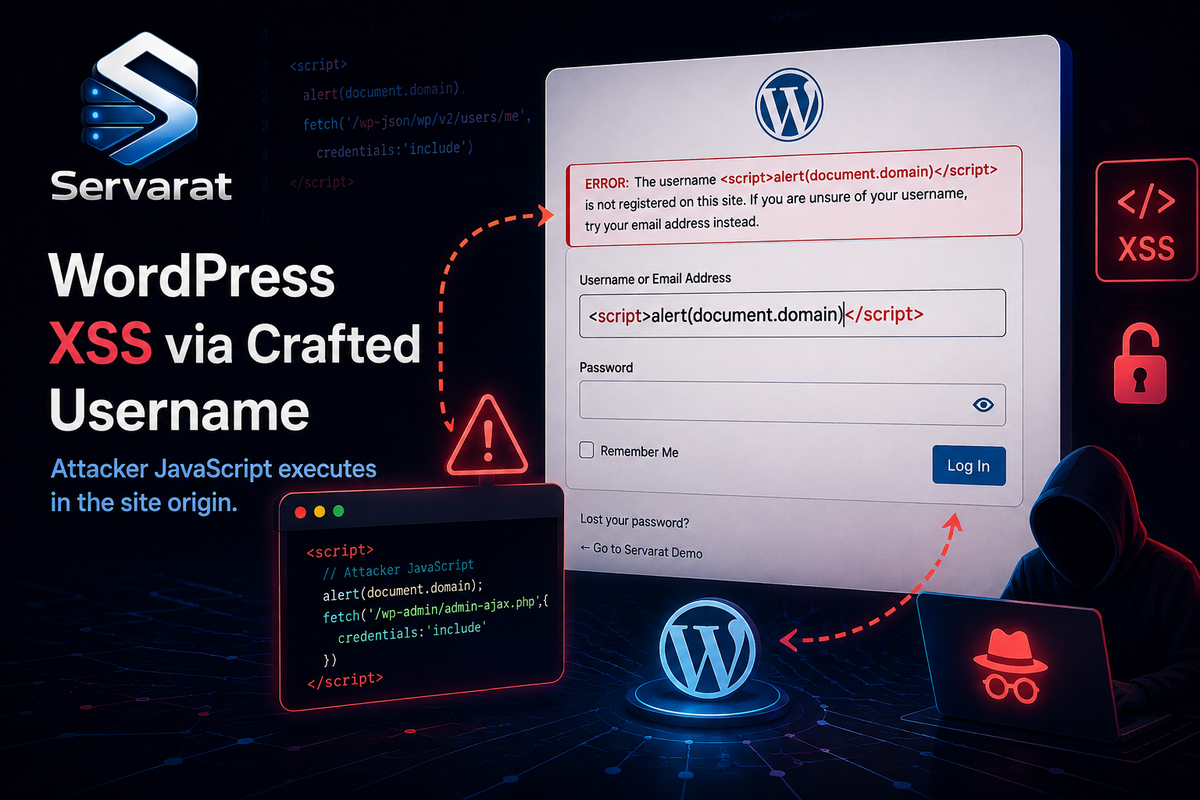
- The XSS. A failed login puts the submitted username on the error page. WordPress runs it through
sanitize_user()andwp_strip_all_tags()(which relies on PHP'sstrip_tags()). ⚠️ The trick: a tag-like string with whitespace right after the opening<survivesstrip_tags()as harmless text. Later, WordPress passes the same value throughwp_kses_post(), whose separate parser interprets that same input as permitted HTML. Two parsers, two interpretations of one string, and the gap between them is attacker-controlled live DOM on the login page. This is the same class of parser-mismatch bug as the wp2shell route confusion, two components disagreeing about what the same bytes mean. - Hijacking WordPress's own JavaScript. Those injected DOM elements interact with
user-profile.js, a profile-management script that's also loaded on the login page (because that page handles password resets). Some elements the script expects are missing there, so two absent inputs both resolve toundefined, letting an equality check pass, and the otherwise-undefinedajaxurlvariable gets clobbered by an injected DOM element. That steers WordPress's own script toward an attacker-chosen same-origin REST request. - JSONP to same-origin execution. The researchers use WordPress's REST JSONP support to turn that request into JavaScript running in the site's origin. ⚠️ For sites where anonymous REST returns HTTP 401, the
_envelope=1parameter wraps the denial in an outer HTTP 200, so jQuery keeps processing the response as script. And notably, they found a nonce-based CSP usingstrict-dynamicdid not block the demonstrated path. - XSS to PHP. Building on Yibelo's SOME technique, one demonstrated path invokes the native Application Password approval control inside the logged-in admin's session. WordPress creates a revocable API credential and redirects it to an attacker's HTTPS
success_url. ⚠️ Because Application Passwords are separate API credentials, this never touches the admin's actual password. The attacker then uses that credential for authenticated REST to publish a page containing same-origin JavaScript; when the admin's retained session opens it, the script grabs the plugin-upload nonce and uploads an attacker ZIP. PHP can be requested directly from the extracted plugin, which never needs to be activated.
The endpoint of a successful chain: wp-config.php database credentials exposed, persistent admin creation, any file or secret the PHP worker can read, and OS commands at the worker's privilege. Full compromise.
What Actually Protects You
⚠️ The researchers are explicit that known WordPress hardening should not be treated as complete mitigation, applying the update is required. That matters because the reflexive "I locked down wp-admin / I have a CSP / I use Application Passwords sparingly" responses don't fully cover this:
- wp-admin IP restrictions and basic auth don't help, the XSS fires on the login page itself, which has to be reachable, and the REST calls ride the admin's own authenticated session.
- A nonce-based
strict-dynamicCSP was bypassed in their testing, so don't count on your CSP. - The Application Password path needs no password theft, so password strength and even primary-credential 2FA don't block that route.
The actual fix is patching to 7.0.3 (or the backported release for your branch). Verify it landed rather than assuming, especially where a plugin or wp-config.php constant disabled auto-updates. Across a cPanel fleet, the same inventory sweep from the wp2shell writeup applies:
for d in /home/*/public_html; do [ -f "$d/wp-includes/version.php" ] && printf '%s: %s\n' "$d" "$(grep -oP "\\\$wp_version = '\K[^']+" "$d/wp-includes/version.php" 2>/dev/null)"; done
Anything below the patched release for its branch needs updating. Find accounts with auto-updates disabled:
grep -rlE "AUTOMATIC_UPDATER_DISABLED|WP_AUTO_UPDATE_CORE.*false" /home/*/public_html/wp-config.php 2>/dev/null
⚠️ One interim hardening that genuinely helps for this specific chain if you can't patch instantly: disable Application Passwords if your site doesn't use them, which removes the demonstrated no-password-theft route to a credential. Add to a must-use plugin or theme functions:
add_filter( 'wp_is_application_passwords_available', '__return_false' );
That's not a substitute for patching (the XSS and other chain variants remain), but it closes the cleanest demonstrated path to persistence.
Detection
Since exploitation is targeted, watch for the signals of a specific admin having been hit rather than mass scanning:
- Requests to
wp-login.phpwith unusuallog=username values containing<followed by whitespace (the XSS trigger). - Unexpected Application Password creation, check
wp_usermetafor_application_passwordsentries you don't recognize. - New pages published via REST with script content, and new plugin ZIPs uploaded.
- ⚠️ New PHP files under
wp-content/plugins/orwp-content/uploads/after August 6:
find /home/*/public_html/wp-content/{plugins,uploads} -name '*.php' -mtime -7 2>/dev/null
Any unexpected PHP there is a finding. If you confirm a hit, work it as a compromise: preserve, find the entry point, hunt persistence beyond the obvious shell, the forensic order from why Linux servers get compromised and the behavioral signals in catching a compromise early.
The Pattern Worth Noting
⚠️ This is the second AI-discovered WordPress core RCE chain in three weeks (wp2shell was the first), and both came from autonomous multi-agent research pipelines pointed at older public research. pwn.ai says XSS2Shell took ~4 days with open-source models. That's the collapsing patch-to-exploit window applied to web apps: the discovery cadence for this class of bug is accelerating, which means the operational answer is structural, keep WordPress auto-updates on and verified across your fleet, because manually tracking a CVE-per-fortnight is a losing game.
Bottom Line
CVE-2026-64638 is a real pre-auth-to-RCE chain, but it's gated by needing to social-engineer a logged-in admin into one click, which makes it a targeted threat, not the internet-wide emergency wp2shell was. Patch to 7.0.3 or your branch's backport, verify it landed (especially where auto-updates were disabled), disable Application Passwords if you don't use them, and don't lean on wp-admin lockdowns or a CSP, the researchers bypassed those. It's a lower-probability event than the last one, but "lower probability" plus "full server compromise if it lands" still means patch now and calibrate, don't panic and don't ignore.
References
- The Hacker News: New WordPress Pre-Auth XSS Could Lead to PHP Code Execution (source)
- pwn.ai: XSS2Shell, WordPress Preauth XSS to RCE Chain (CVE-2026-64638)
- WordPress 7.0.3 Security Release
- GitHub Advisory GHSA-52p2-r8wf-jcrf
- Patchstack: WordPress 7.0.3 Released, 12 Vulnerabilities Fixed
- Paulos Yibelo: Same Origin Method Execution (SOME)