When a Government Pulls an AI Model: What the Fable 5 and Mythos 5 Suspension Means for Security Teams

A Model Vanished for Everyone, in Hours
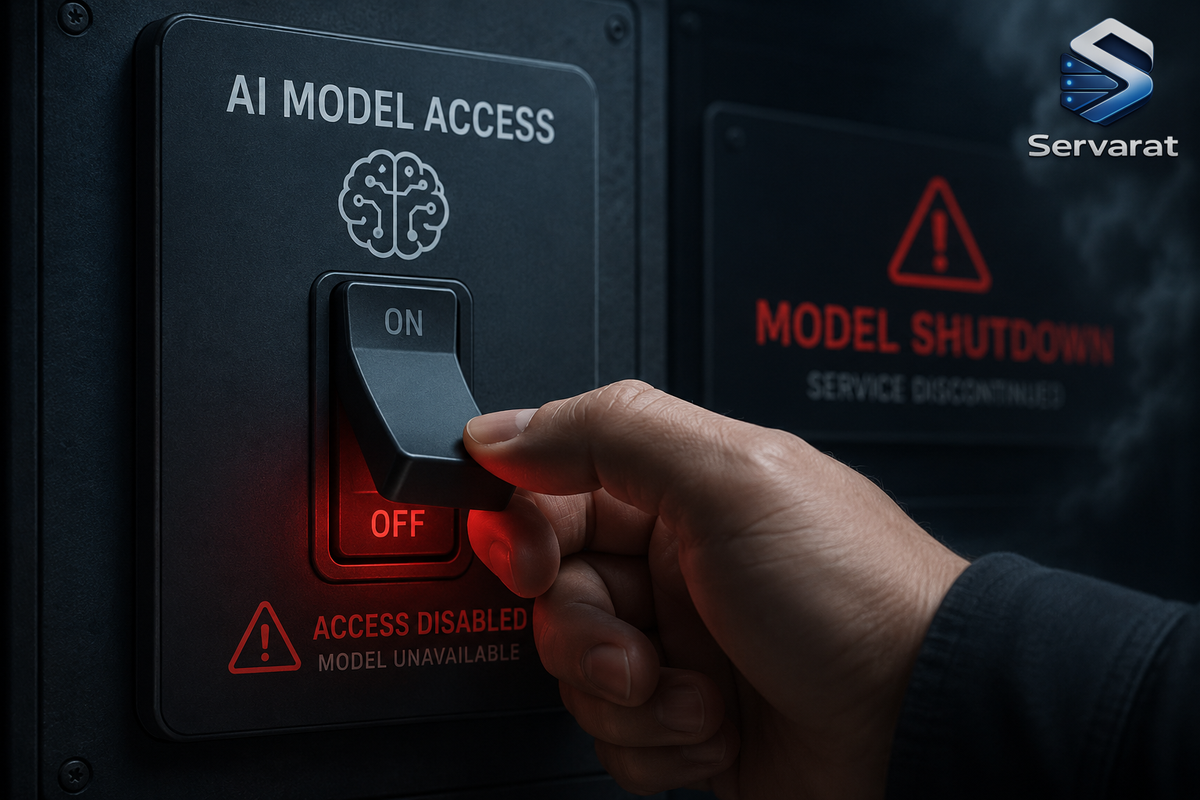
On the evening of June 12, 2026, Anthropic disabled access to two of its newest models—Claude Fable 5 and Claude Mythos 5—for every customer worldwide. Not because of an outage or a self-discovered flaw. To comply with a US government export-control directive, received at 5:21 PM ET that day, citing national security authorities.
For a security audience, the details matter more than the politics: what the reported trigger actually was, how the action played out, and what it reveals about depending on someone else's model. Those are questions security teams can act on, wherever they land on the policy debate.
What Actually Happened
The shorthand circulating online—"the government banned the model for everyone"—isn't quite what the record says.
According to Anthropic's statement, the directive ordered the company to suspend all access to Fable 5 and Mythos 5 by any foreign national, whether inside or outside the United States, including foreign national Anthropic employees. The restriction, on its face, targeted foreign-national access, not all users. Fortune reported the directive came from the U.S. Commerce Department using national security export controls.
The global shutdown was the practical consequence. There's no reliable way to segment foreign nationals from US persons in real time across a user base in the hundreds of millions—particularly on same-day notice—so the company turned the models off for everyone to ensure compliance. The order targeted foreign-national access; the only way to enforce it on short notice was a blanket shutdown. Access to all other Anthropic models, including Claude Opus 4.8, was unaffected.
The stated reason was a reported "jailbreak." Anthropic characterized the evidence it was given as verbal only—a potential narrow, non-universal jailbreak that essentially consists of asking the model to read a specific codebase and fix any software flaws. The company argued that level of capability is widely available from other models, including OpenAI's GPT-5.5, and is used every day by defenders.
The government has not published the directive, and the letter didn't provide a specific technical basis, so the public picture largely rests on Anthropic's account. Frontier-model cyber capability is a legitimate category of national-security concern, and reporting indicates the directive followed a third party's jailbreak claim. What can be examined is the shape of the action and how it compares to established security practice—not the classified specifics.
The Reported Trigger: Code Analysis and Remediation
Asking a model to read a codebase and fix its flaws is not an exotic attack. It's automated code review and vulnerability remediation—the same job done by static analysis, fuzzers, AI-assisted code review, and every security engineer who's run a scan before a release. It's a capability defenders routinely use, and like most security capabilities, it's dual-use by nature.
The technical community made this point fast. The objection on Hacker News was blunt: if the "jailbreak" is asking the model to fix a codebase and it exposes the flaws in the process, that's a gap that's nearly impossible to close while keeping the model capable. You want it to be able to fix your codebase. There's no version of a capable coding model that can fix vulnerabilities but can't also describe them.
The irony: in the days before the suspension, some researchers had the opposite complaint—that Fable 5's guardrails were too aggressive for legitimate defensive work. IBM X-Force's Valentina Palmiotti told TechCrunch the model rejected nearly any request that could be tangentially cyber-related. Within the same week, the model was criticized for being too restrictive for defenders, then withdrawn over a capability used in defense.
Dual-use is a familiar property in security. A port scanner, a packet analyzer, a fuzzer, a SAST engine, a debugger, a memory-corruption proof-of-concept—all are "offensive" and "defensive" tools depending on who's holding them and why. We don't ban nmap. We don't classify Wireshark as a weapon. The field concluded long ago that you can't improve defense while forbidding the tools defense requires.
How Security Handles Dual-Use Risk
The general problem is old: a powerful capability exists and could be misused. The field has spent decades building an answer, and it rests on a few disciplines worth restating here.
Coordinated disclosure. When someone finds a serious flaw, the norm is to report it privately to the party who can fix it, agree on a timeline, and publish once a remediation exists—reducing harm while still moving the ecosystem forward. By Anthropic's account, it received only verbal evidence and wasn't given the specific finding in writing. The government hasn't described its own process publicly.
Defense in depth. No single control is expected to be perfect, so you layer controls and assume some will fail. Anthropic said at launch it built Fable 5 on exactly this principle—accepting that perfect jailbreak resistance probably isn't possible for any provider, aiming to make jailbreaks narrow or expensive to produce, and pairing that with monitoring to detect and shut down successful attacks. Same logic as layered appsec: scanning in the IDE, checks in the pull request, gates in CI, monitoring in production. The expectation isn't that nothing gets through. It's that the layers catch and contain what does.
Risk-based prioritization. Mature programs don't treat every finding as a five-alarm fire. When a critical CVE drops in a popular npm package, the ecosystem doesn't take all of npm offline—it triages by exploitability and reachability, prioritizes what actually matters, patches, and verifies. Severity is necessary but not sufficient; the useful question is always which risks are real, reachable, and most important to act on first. Security teams rarely face a clean binary of fully on or fully off. The practice is to find the graduated response that fits the actual risk.
How this specific action maps onto those practices is hard to judge from the public record. What the practices offer is a shared frame for the debate that followed.
How the Reaction Split
Public reaction divided fast. One argument noted that Anthropic had publicly called for government authority over AI deployments and was now objecting when a version of it was used. Anthropic's response: it agrees governments should be able to block unsafe deployments, but only as part of a statutory process that's transparent, fair, clear, and grounded in technical facts—and it argued this action didn't meet those principles. The government's stated basis was national security, a recognized concern for frontier cyber capability. The specific evidence hasn't been made public.
Other reactions had little to do with either party. Developers who'd built on Fable 5 focused on reliability, and many treated the episode as an argument for open-weight or self-hosted models that can't be cut off from outside. A few read it skeptically as pre-IPO publicity—Anthropic had filed a confidential IPO prospectus earlier that month.
There's precedent. In the 1990s, the US treated strong encryption as a controlled munition and restricted its export, and US courts ultimately found that publishing security code is protected expression. But those controls restricted export; they didn't force an already-deployed product offline for domestic users. That's one way this case differs.
The Reliability Angle Security Teams Can't Ignore
Set the legal questions aside. There's an operational lesson here that holds regardless of how the policy debate resolves.
A single directive took a generally available product offline for its entire global user base within hours. For anyone who'd built Fable 5 into a workflow, the model's availability was revocable by forces beyond their control and their vendor's. The takeaway builders landed on in real time: model redundancy is now a resilience requirement, not just a cost or performance consideration.
⚠️ Treating a single hosted model as a hard dependency is a single point of failure—and single points of failure are a security problem whether they fail from an outage, a billing event, a policy change, or a government letter. The Fable 5 suspension is a live demonstration of why. If your incident-response runbooks assume your AI provider is always reachable, you have an untested failure mode sitting in production right now.
This is the same discipline you'd apply to any other part of the supply chain. You can't manage what you can't see: know your AI blast radius, inventory where AI components and dependencies actually live in your systems, and plan for the failure of any one of them.
What This Means in Practice
The policy debate will run for a while, and reasonable people will disagree on whether governments should be able to take a deployed model offline. For security teams, the durable takeaways don't depend on who's right.
- Don't let any single hosted model be a hard dependency. Build model redundancy and graceful fallbacks into anything that matters. Availability you don't control is a risk you have to plan for. In practice: abstract your model calls behind an interface, keep at least one alternative provider wired and tested, and have a documented fallback path (including to a self-hosted or open-weight model) for critical workflows.
- Inventory where AI lives in your stack. You can't reason about blast radius without asset discovery. Know which services, pipelines, and products depend on which models and AI components. ⚠️ This includes shadow usage—developers wiring an API into a side service without telling anyone is exactly the dependency that bites you during a sudden cutoff.
- Scan AI-generated code as a default, not an afterthought. AI writes more code, faster, and not all of it is safe. Point-of-creation and pull-request scanning, with automated remediation where possible, keeps speed and safety together rather than in tension.
- Prefer guardrails and monitoring over kill switches. The useful unit of control is usually the action, not the whole model. Constrain what an agent can do, monitor it, and intervene narrowly. Reserve full removal for cases that genuinely warrant it—and define in advance what those are.
- Practice coordinated disclosure, and expect it from others. A finding you can't see is a finding you can't fix. Insist on evidence and a remediation path, and extend the same to others.
Conclusion
The Fable 5 and Mythos 5 suspension will be argued about on legal and political grounds for a while. For security teams, the durable lessons sit underneath that argument. The capability at the center of the dispute is one defenders use routinely. The practical result—a globally available dependency removed within hours—is a concrete argument for redundancy and visibility.
Powerful, dual-use capability isn't a new problem, and the field already has the playbook: keep enough model redundancy that no single provider is a hard dependency, know where AI lives in your stack, scan AI-generated code as it lands, put guardrails around what AI can do instead of reaching for kill switches, and practice coordinated disclosure in both directions. Applied continuously, that's how teams keep shipping through dual-use risk—whatever the policy outcome turns out to be.
References
- Snyk: When a Government Pulls an AI Model — What the Fable 5 and Mythos 5 Suspension Means for Security Teams (Source)
- Anthropic: Statement on the US Government Directive to Suspend Access to Fable 5 and Mythos 5
- CNBC: Anthropic Disables Access to Fable 5 and Mythos 5 to Comply With Government Directive
- Fortune: Anthropic Disables Fable and Mythos AI Models Following U.S. Government Export Ban
- VentureBeat: Anthropic Blocks All Public Access to Claude Fable 5, Mythos 5 — What Enterprises Should Do
- Al Jazeera: US Orders Anthropic to Disable AI Models for All Foreign Nationals
- OWASP Top 10 for LLM Applications