The Patch-to-Exploit Window Just Collapsed: What It Means for Your Patching Cadence

Meta Description
Featured Image Alt Text
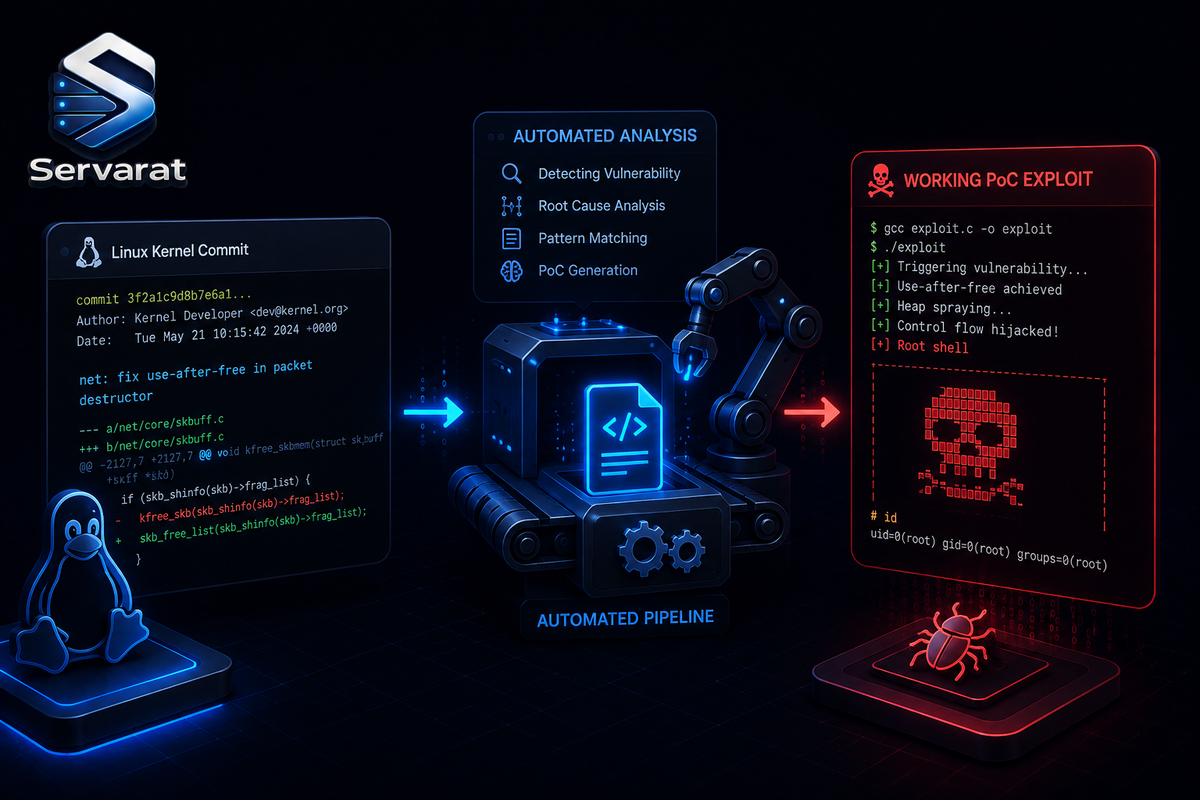
Here's the operational fact underneath a lot of recent AI-security research, stated plainly: the time between a Linux kernel patch going public and a working exploit existing has dropped from days-of-expert-effort to minutes-of-automation. Academic systems now reproduce over half of real kernel vulnerabilities directly from the fixing commit, no advisory needed. MaK Ulac's LinuxSecurity feature lays out the research well, but stops at the analysis. The question it doesn't answer is the one you actually have to act on: if the patch-to-exploit window collapsed, what changes about how and when you patch? That's what this is about.
The Research, Briefly, So the Numbers Are Grounded
Three systems, three stages of the same pipeline, all real and verifiable:
- Akamai's PatchDiff-AI (December 2025) answers "what changed?" On a Microsoft NTFS advisory it identified the affected binary (
ntfs.sys), narrowed to the vulnerable function (ReadRestartTable()), and produced a root-cause explanation. Across its evaluation set: patched executable identified in 88.6% of cases, vulnerable function in 83.9%, root cause in 71.4%. - K-Repro (Patch-to-PoC, arXiv:2602.07287, UC Riverside) answers "can it reproduce the bug?" It's an agentic system that ingests a kernel patch, boots a vulnerable kernel in a VM, drives GDB, and iterates on a PoC. Against 100 real KernelCTF vulnerabilities, it reproduced 56 of 100, including bugs disclosed after the model's knowledge cutoff, at practical time and cost.
- PoCEvolve (arXiv:2607.22076) answers "how much can be inferred from the commit alone?" generating proof-of-concept exploits from public fixes using vulnerability-aware prompt evolution, across Windows binaries, Linux kernel commits, and JavaScript.
The convergence is the point. Three independent groups, different targets, same underlying capability: parse a fixing commit, understand the vulnerability's mechanics. Once that's automatable, a PoC is just one of the outputs, alongside root-cause summaries, regression tests, and detection logic.
⚠️ Keep the numbers in proportion, because the honest read matters. 56% reproduction on a curated CTF dataset of known-exploitable bugs is not "AI exploits any patch instantly." KernelCTF vulnerabilities are selected for reproducibility; your average messy subsystem fix is harder. But the direction and the cost collapse are the real signal: work that required a scarce specialist and hours-to-days now runs as an automated loop for the price of some compute. That's the part that changes your threat model, not any single percentage.
Why This Isn't Just "AI Writes Exploits"
The framing that misses the point is "AI writes exploits now." It does, sometimes, but that's the least important consequence. The load-bearing shift is that the disclosure gap became exploitable at scale.
Every public kernel fix opens a window: the commit lands in the public tree before a detailed advisory, CVE, or vendor bulletin exists. During that window, the fix is the vulnerability disclosure, if you can read it. Historically that reading required a kernel reverse engineer, which rate-limited how fast attackers could weaponize a fresh commit. That rate limit is what's disappearing. Automated analysis can now flag likely-vulnerable commits, extract the affected function and call path, and surface exploitability hints in the same window, before the advisory that would have told defenders to prioritize even exists.
This is the mechanism behind something I've flagged repeatedly on this blog without naming the cause. The pedit COW disclosure timeline showed a security-relevant fix sitting on the netdev mailing list for weeks with no CVE and no security label, and a weaponized PoC landing within a day of the CVE assignment. The DirtyClone family showed researchers auditing the exact residual code paths earlier fixes left open. And the curl 18-CVE release was the defensive mirror image: AI-assisted research surfacing decades-old bugs in a compressed window. The research in this piece is the general engine behind all three specific stories.
What Actually Changes for You
The source correctly says the concern isn't instant exploits, it's that attackers understand a fresh patch faster. True. But "patch faster" is not an action, it's a platitude. Here's the concrete version.
The traditional patch cadence assumed a buffer: a patch drops, and you have some days before a reliable exploit exists in the wild, so a weekly or monthly maintenance window is a reasonable risk trade for most systems. That buffer assumption is what's breaking. For the class of bugs this automation handles well (self-contained kernel LPEs with clear fixing commits), the safe planning assumption is now that a working PoC can exist within the disclosure gap, before you've even seen an advisory.
That doesn't mean patch everything instantly, which is neither possible nor wise. It means re-tiering what gets the collapsed-window treatment:
| Workload class | Old cadence | Revised assumption |
|---|---|---|
| Internet-facing / multi-tenant / untrusted local users | Patch in the next window | Assume exploit exists at disclosure; patch or mitigate same-day for kernel LPE and RCE classes |
| Single-tenant, no untrusted local access | Monthly | Prioritize by whether the bug needs local access you actually grant; the LPE window matters less if nobody untrusted has a shell |
| Air-gapped / no untrusted input path | As convenient | Largely unchanged; the exploit-speed collapse only matters if there's a path to reach it |
⚠️ The practical filter is unchanged in principle but more urgent in timing: does an attacker have a path to reach the vulnerable code before you patch? A kernel LPE is a same-day problem on a box where untrusted users get shells (CI runners, shared hosts, multi-tenant clusters) and a schedule-it problem on a single-tenant appliance. The AI-speed collapse doesn't change that logic, it shrinks the time you have to act on it once a bug lands in the first bucket.
The Mitigation That Buys Back the Window: Live Patching
If the window between disclosure and exploit is collapsing, the highest-value defensive move is closing your own window between disclosure and deployment, and that's exactly what live kernel patching does. KernelCare, kpatch, or Ubuntu's Livepatch apply kernel fixes without a reboot, which removes the single biggest reason kernel patches sit undeployed: the maintenance window required to reboot a fleet.
⚠️ This is the direct counter to the threat this research describes. If a PoC can exist same-day, then a patching process that requires scheduling a reboot weeks out is structurally too slow, and live patching is how you compress deploy-time to match. I covered the options in the kernel patching approaches guide, and this research is the strongest argument yet for adopting live patching on anything internet-facing or multi-tenant. Verify your live-patch coverage actually includes the CVE classes you care about, since live patches lag full kernel updates for some bug types.
For the gaps live patching can't cover, the fallback is the surgical mitigation pattern this blog keeps returning to: block the vulnerable module or capability rather than waiting on the kernel fix, exactly the act_pedit modprobe block and userns restriction used against the recent page-cache COW wave. Automation shortening the attacker's timeline makes those interim mitigations more valuable, not less.
The Defensive Half Nobody Should Ignore
The same capability cuts both ways, and defenders get the better end if they use it. The identical pipeline that produces an attacker's PoC produces a defender's regression test, detection rule, and reachability check. K-Repro reproducing a bug in a VM is exactly what you need to confirm a mitigation works or verify a fix actually closed the path before you trust it in production.
⚠️ The asymmetry that favors defenders: you have information attackers don't, your own inventory. An attacker with an automated PoC still has to find you and reach the vulnerable code. You already know which of your hosts run the affected kernel, which expose the vulnerable path, and which grant the access the exploit needs. Automated patch analysis tells you a commit is dangerous fast; pairing that with fleet inventory (which of my boxes is actually exposed to this?) is the move that keeps defenders ahead. That's the same behavioral-and-inventory discipline from catching a compromise early, applied at the patch-triage stage rather than post-breach.
Bottom Line
The research is real and the numbers, kept in proportion, are a genuine threat-model shift: over half of curated kernel bugs reproduced automatically from the fixing commit, at compute prices, closing the disclosure gap that used to protect slow patchers. The action isn't panic, it's re-tiering. Assume a same-day exploit for kernel LPE and RCE classes on any host where untrusted code can reach them, adopt live patching to compress your deploy window to match the collapsing exploit window, keep the surgical module-block mitigations ready for the gaps, and use the exact same automation defensively to validate fixes and prioritize by your own inventory. The patch always contained the vulnerability. What changed is that reading it is no longer the slow part, so being slow to deploy is now the expensive part.
References
- LinuxSecurity: Linux Security Patches Have Become Machine-Readable Intelligence (source, by MaK Ulac)
- Patch-to-PoC: Agentic LLM Systems for Linux Kernel N-Day Reproduction (K-Repro, arXiv:2602.07287)
- PoCEvolve: Generating PoC Exploits from Security Patches (arXiv:2607.22076)
- Akamai: PatchDiff-AI Research
- KernelCTF Vulnerability Dataset
- Ubuntu Livepatch Service