RoguePlanet: Windows Defender Race Condition Zero-Day Leads to SYSTEM Privilege Escalation

The Exploit That Shouldn't Exist: Microsoft Defender's Race Condition
A Windows zero-day dubbed RoguePlanet has been released publicly. It exploits a race condition in Microsoft Defender to escalate privileges from a standard user to SYSTEM level. The exploit was released by Nightmare Eclipse (also known as Chaotic Eclipse), a researcher who's been systematically disclosing Windows zero-days over the past months—and expressing growing frustration with Microsoft's response.
What makes RoguePlanet significant: it works on fully patched Windows 10 and Windows 11 systems as of June 2026. Security researchers have independently validated the proof-of-concept. Microsoft has not yet issued a patch.
RoguePlanet: The Vulnerability
Type: Race condition in Microsoft Defender
Impact: Local privilege escalation to SYSTEM
Affected: Windows 10 and Windows 11 (not Windows Server, despite vulnerability being present)
Status: Unpatched (as of June 2026)
PoC Status: Publicly released, independently validated
How It Works: The Original Attack
RoguePlanet originally exploited a more ambitious attack chain that led to remote code execution:
- Attacker hosts malicious .vhd(x) file on a remote SMB server or creates a malicious SMB share
- Victim opens the malicious file (via SMB share or local access)
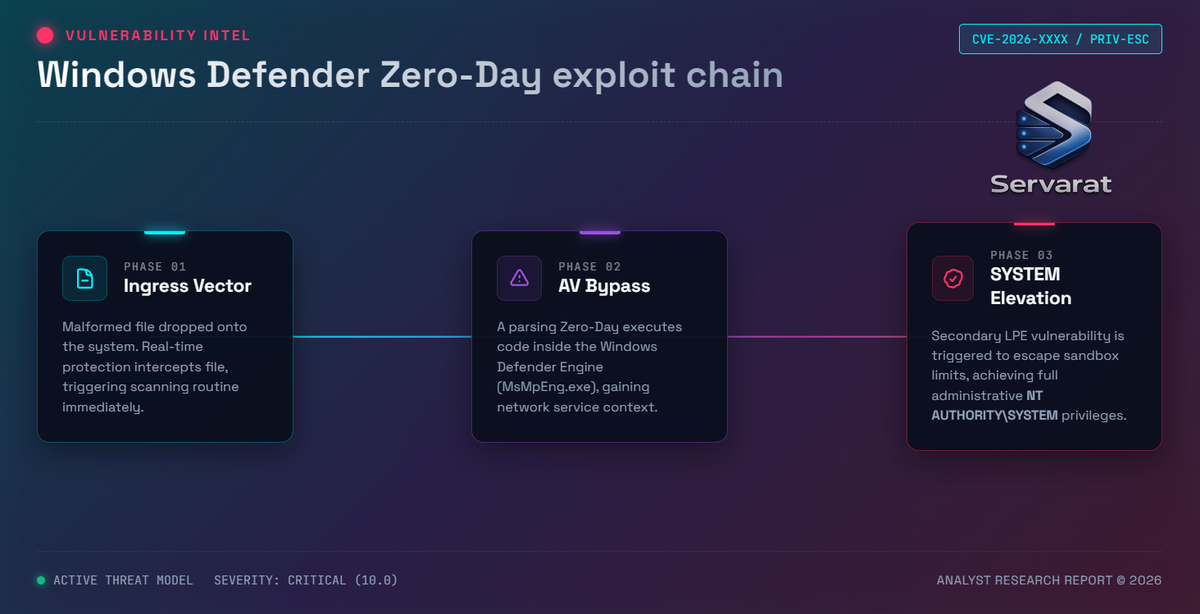
- Microsoft Defender scans the file and detects the malware
- Exploit exploits race condition in Defender's file handling
- Defender "cleans" the malware, but the exploit redirects the cleaned file to a new location
- Attacker's code executes with privileges of the process that read the file
This attack path also enabled BitLocker bypass using a specialized device designed to push data to the NTFS file system. Once Defender read the malicious file, the exploit would manipulate where the cleaned file ended up.
Why Microsoft's May Patches Broke The Exploit
Microsoft's May 2026 Patch Tuesday updates closed some of these attack paths. The researcher had to completely rework the exploit—a significant effort. The public RoguePlanet PoC is now limited to local privilege escalation, not RCE. Whether it can be redesigned for RCE is unclear.
The Current PoC: LPE via Race Condition
The race condition itself is in how Defender handles file access during malware cleaning. The attack timeline:
- Attacker process initiates file access with specific flags
- Defender scans and begins cleanup
- Attacker exploits timing window between Defender's scan and cleanup completion
- Race condition occurs: Defender's cleanup logic and attacker's code execute simultaneously on the same file
- Result: Attacker gains elevated privileges, can spawn SYSTEM-level processes
This is not a sophisticated exploit technically. It's a timing attack that exploits a logic flaw in Defender's race condition handling.
Attack Scenario: From User to SYSTEM
Prerequisites:
- Local user account (any privilege level)
- Ability to run code
- Access to file system
Attack steps:
- Create or place a file that triggers Defender scanning
- Run the RoguePlanet PoC
- Wait for Defender to scan (happens automatically on file activity or scheduled scans)
- Exploit race condition during Defender's cleanup phase
- Spawn cmd.exe with SYSTEM privileges
- Attacker now has full system access
The attack requires no user interaction beyond the initial file placement. Defender's automatic scanning provides the timing window. The race condition is deterministic enough that the PoC works reliably on most systems.
Vulnerability Timeline
May 2026: Microsoft patches some RoguePlanet attack paths
Late May 2026: Nightmare Eclipse reworks exploit to focus on LPE via Defender race condition
Early June 2026: RoguePlanet PoC released publicly
June 10, 2026: Multiple security researchers independently validate the exploit on patched systems
June 2026 Patch Tuesday: Microsoft patches two other Nightmare Eclipse exploits (GreenPlasma, YellowKey) but not RoguePlanet
The Researcher and Motivation
RoguePlanet is the latest in a series of Windows zero-days released by Nightmare Eclipse:
- GreenPlasma (CVE-2026-45586): CTFMON elevation of privilege
- YellowKey (CVE-2026-50507): BitLocker bypass
- RedSun (CVE-2026-41091): Elevation of privilege (exploited in the wild)
- UnDefend (CVE-2026-45498): Windows Defender bypass
- BlueHammer (CVE-2026-33825): Another elevation of privilege (exploited in the wild)
According to the researcher, the motivation is frustration with Microsoft's vulnerability disclosure process and treatment. Nightmare Eclipse has expressed discontent with:
- How Microsoft handles responsible disclosure
- How the company treated the researcher
- The pace and quality of patching
- The lack of communication
Microsoft's Response: Escalation
Initial Microsoft statement: Called for responsible disclosure and threatened legal action against "anyone engaging in malicious cyber activities or helping miscreants."
Community backlash: Security researchers criticized Microsoft for conflating security research with malicious activity.
Microsoft clarification: Said it would not "pursue action against individuals conducting or publishing their security research."
Contradiction: Nightmare Eclipse claims Microsoft filed legal action against them anyway. Microsoft also suspended their GitHub account.
Result: RoguePlanet was published from a new account named "MSNightmare," likely created to evade the account suspension.
Implications
For Windows Users
RoguePlanet demonstrates that Microsoft Defender can be exploited to gain SYSTEM privileges. Any attacker with local user access can use this to escalate to full system control. This is a local attack, but:
- Compromised service accounts can escalate
- Remote code execution (if achieved) enables local attack
- Supply chain compromises that deliver files enable the attack
- Malware that achieves user-level code execution can escalate
For Enterprise
Organizations running Windows 10/11 are vulnerable until patched. The race condition is not trivial to fix; it requires understanding Defender's internal state machine and timing. A fix likely requires:
- Serializing file access during cleanup (slow)
- Adding synchronization primitives (complexity)
- Redesigning the cleanup logic (effort)
For Windows Security Posture
This is the sixth Windows zero-day released by Nightmare Eclipse in a few months. The pattern suggests:
- Defender has exploitable logic issues: Race conditions in a security product are critical
- Researcher has deep Windows knowledge: Multiple exploits across different subsystems (Defender, CTFMON, BitLocker, privilege elevation mechanisms)
- Microsoft's patch process is incomplete: Some attack paths closed but core vulnerabilities remain
- Responsible disclosure is breaking down: Legal threats and account suspension are escalating tensions, not resolving them
Detection and Mitigation
Before Patch
Detection is difficult because the attack exploits Defender's own cleanup process. Logging what you'd need to detect (race condition details, privilege escalation via Defender) is not enabled by default.
General detection strategies:
- Monitor for unusual SYSTEM-level process creation from user contexts
- Alert on unexpected elevations of privilege
- Log Defender scan events and cleanup actions
- Track file access patterns that might trigger race conditions
Real mitigation: None beyond the patch. The race condition is fundamental to how Defender cleans files. Workarounds (disabling Defender, changing scan settings) introduce other security gaps.
After Patch
Once Microsoft issues a patch (expected imminently):
# Windows Update
Settings → Update & Security → Windows Update → Check for updates

# Or via WSUS/SCCM for enterprise
Patch immediately. This is a SYSTEM-level privilege escalation in your security product.
The Broader Context: Windows Zero-Days as a Disclosure Tactic
Nightmare Eclipse's approach—disclosing multiple Windows zero-days in a compressed timeline—is unprecedented in recent years. The pattern suggests:
- Research depth: The researcher or team has spent significant time analyzing Windows internals
- Frustration with process: The shift from responsible disclosure to public PoC release indicates frustration with Microsoft
- Signal amplification: Multiple zero-days attract media attention and pressure
- Bargaining position: Public zero-days force Microsoft to prioritize patching
Microsoft's response—legal threats followed by clarification—suggests the company underestimated the security community's reaction to attacking researchers.
Timeline of Windows Zero-Days (2026)
- April 2026: RedSun and BlueHammer released (both later exploited in the wild)
- May 2026: UnDefend and related flaws disclosed
- Early June 2026: GreenPlasma and YellowKey patched in Patch Tuesday
- Early June 2026: RoguePlanet released
- June 2026: Additional details about race condition emerge
- Expected: Microsoft patches RoguePlanet in July or earlier emergency update
References
- SecurityWeek: RoguePlanet Windows Zero-Day Released (Source)
- Microsoft Security Response Center
- Microsoft Defender Documentation
- Race Condition Vulnerabilities (CWE-362)
- Windows Privilege Escalation Techniques
- Microsoft Patch Tuesday
- Nightmare Eclipse / Chaotic Eclipse Disclosures
- CVSS Scoring for Privilege Escalation