How Large-Scale Platforms Handle Millions of Daily Transactions

The Few Seconds the User Sees, the Millions of Transactions They Don't
Every day, millions of people order food, stream videos, send messages, book rides, make payments, and shop online. From the user's perspective, each action takes a few seconds. Click a button, get a response, done.
Behind the scenes, these platforms process enormous volumes. A single popular application may handle thousands of requests per second and millions of transactions per day. Each one has to be processed accurately, securely, and quickly.
This article walks through how large-scale platforms manage that volume, the engineering challenges involved, and the architectural patterns developers use to build reliable systems.
Why Transaction Volume Creates Unique Challenges
Handling a few hundred transactions a day is straightforward. A single server and database manage it without difficulty. The challenge emerges as usage grows into thousands or millions of simultaneous users.
Consider an online marketplace operating across multiple countries. At any moment, thousands of users may be placing orders. Inventory updates in real time, payments process accurately, notifications deliver, and fraud detection evaluates transactions before approval—all within seconds.
At scale, even a minor delay affects thousands of users. Systems must maintain low response times while preventing database bottlenecks, avoiding duplicate transactions, absorbing unexpected traffic spikes, and staying reliable when failures occur. The solution is distributed systems and scalable architectural patterns.
Breaking Monoliths Into Services
Many successful platforms start as monoliths—all functionality in a single codebase. That works well early, but it gets harder to scale as transaction volume grows.
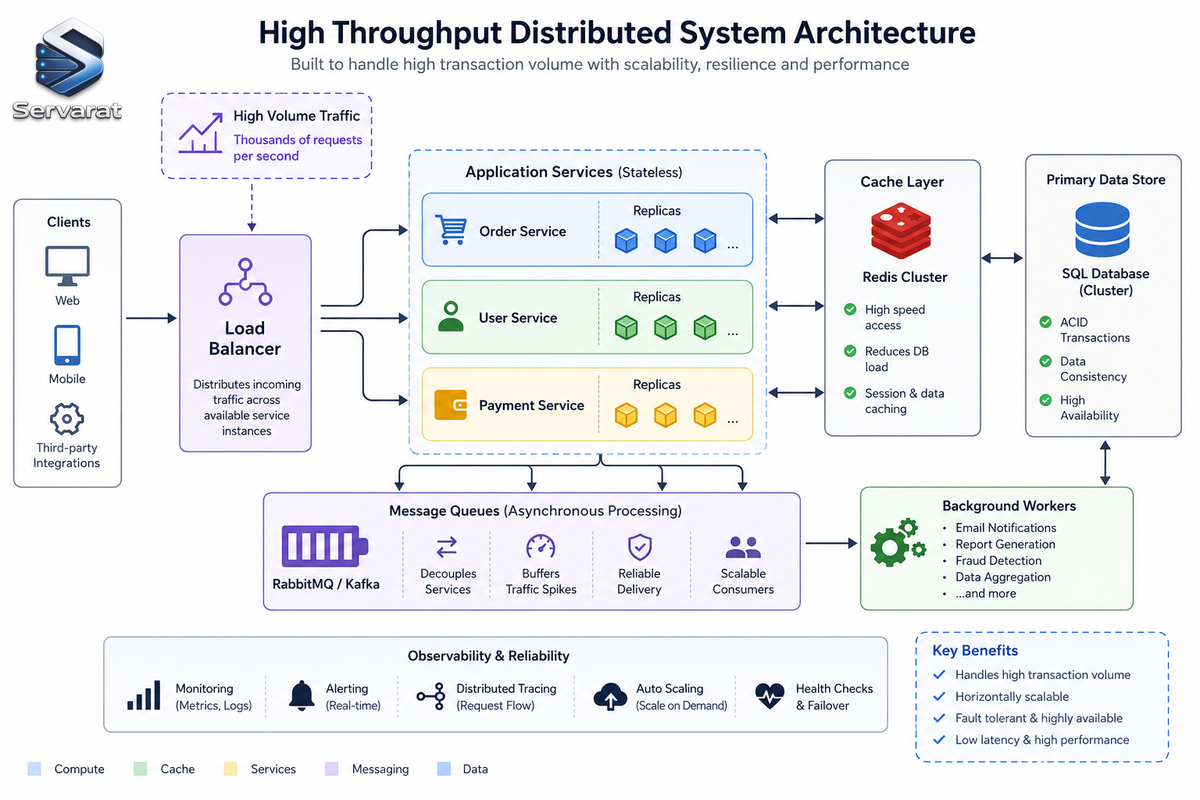
Large platforms often adopt a service-oriented architecture instead. Rather than one application handling everything, individual services own specific business functions: user management, payments, inventory, notifications, analytics.
A simplified order-processing workflow:
def create_order(user_id, product_id):
    inventory.reserve(product_id)

    payment_result = payment.charge(user_id)

    if payment_result.success:
        order.create(user_id, product_id)
        notification.send_confirmation(user_id)

    return payment_result
This separation lets each service scale independently. If payment activity spikes, engineers allocate more resources to the payment service without touching the rest of the platform. It also lets teams develop, deploy, and maintain services independently, improving agility and reliability.
Using Load Balancers to Distribute Traffic
No single server handles millions of daily transactions on its own. To distribute requests, platforms put load balancers in front of their application servers.
Instead of connecting directly to a server, users send requests to a load balancer, which decides which server is best positioned to handle each request based on current load, availability, and health.
Users
   |
Load Balancer
   |
-------------------
|        |        |
Server1 Server2 Server3
If one server becomes overloaded or fails, traffic redirects to healthier servers. This improves both performance and availability. Modern cloud providers offer managed load-balancing that automatically distributes traffic based on resource utilization and server health.
Why Databases Become Bottlenecks
Scaling application servers is relatively easy. Databases are usually the most significant bottleneck in transaction-heavy systems.
Every transaction ultimately reads or writes data. Consider a task management platform where users complete tasks and receive rewards. Each completed task may trigger multiple database operations: verifying completion, updating account balances, recording transaction history, generating audit logs.
A common solution is read replication. Instead of one database instance, platforms create replicas that handle read requests while the primary focuses on writes:
Primary DB
     |
-------------------------
|         |            |
Replica1 Replica2 Replica3
Distributing read traffic across replicas reduces pressure on the primary and improves response times.
⚠️ Replicas come with replication lag. Don't route consistency-sensitive reads (payment confirmations, balance checks immediately after a write) to a replica that might be a few seconds stale.
Caching Frequently Accessed Data
Not every request needs to reach the database. Repeatedly querying for the same information increases both cost and response time.
Platforms use caching systems like Redis to store frequently accessed data in memory. User profiles, product details, and application settings change infrequently and can be served from cache.
Without caching:
user = database.get_user(user_id)
With caching:
user = cache.get(user_id)

if not user:
    user = database.get_user(user_id)
    cache.set(user_id, user)
Memory access is substantially faster than database queries. At millions of requests per day, caching dramatically improves performance while reducing backend load.
Processing Tasks Asynchronously
Users expect immediate responses. If every operation has to finish before the system responds, applications become sluggish under heavy load.
Large-scale systems separate critical user-facing actions from background work. Consider a payment. The user needs confirmation the payment succeeded—but they don't need to wait for analytics updates, report generation, or email delivery.
A synchronous implementation:
process_payment()
send_email()
update_analytics()
generate_report()
A more scalable approach uses message queues:
process_payment()

queue.publish("send_email")
queue.publish("update_analytics")
queue.publish("generate_report")
Background workers consume these queued tasks and process them independently. This improves user experience and lets systems handle significantly larger volumes.
Preventing Duplicate Transactions
One of the most important challenges in transaction processing is preventing duplicate execution.
Network interruptions can cause users to unknowingly submit the same request multiple times. Imagine a customer making a purchase. The payment succeeds, but the confirmation never reaches their device because of a network failure. Believing it failed, the customer clicks again.
Without safeguards, the platform charges them twice.
Many systems solve this with idempotency keys:
def process_payment(request_id, amount):

    if payment_exists(request_id):
        return existing_payment(request_id)

    payment = create_payment(request_id, amount)
    return payment
If the same request arrives again, the system returns the original result instead of processing a second payment. This pattern is widely used in financial services, payment gateways, and banking applications.
⚠️ The idempotency key must come from the client and stay stable across retries. Generating it server-side defeats the purpose—each retry would look like a new request.
Monitoring Everything
As systems grow more complex, visibility becomes essential. You can't troubleshoot what you can't observe.
Modern platforms collect metrics from every layer: request latency, database response times, error rates, queue depth, CPU utilization, memory consumption.
A simple monitoring rule:
if error_rate > 5:
    alert("High error rate detected")
Monitoring lets teams identify problems before they impact users. It also provides data for performance optimization and capacity planning.
Preparing for Traffic Spikes
Traffic patterns are rarely predictable. An e-commerce platform sees enormous demand during holiday sales. A ticketing site can receive millions of requests within minutes when a popular event goes live.
To handle surges, platforms rely on autoscaling. Cloud infrastructure automatically adds resources as demand increases and removes them when traffic subsides:
if cpu_usage > 70:
    add_server()
Autoscaling maintains performance during peak periods while controlling costs during quieter times.
Building for Failure
One of the most important principles in distributed systems: failures are inevitable. Servers crash. Databases become unavailable. Networks experience interruptions. Rather than hoping these never happen, large-scale platforms design systems that keep operating when they do.
Payment systems often include retry logic:
for attempt in range(3):
    try:
        charge_customer()
        break
    except:
        continue
⚠️ Retry logic and idempotency must work together. Blind retries without idempotency keys are exactly how you double-charge a customer—the retry succeeds on a request that already went through. Pair every retry loop with an idempotency check.
Platforms also implement redundancy by running multiple instances of critical components across different geographic regions and availability zones. If one component fails, another takes over with minimal disruption. This significantly improves availability and resilience.
The Importance of Consistency and Reliability
At scale, transaction processing isn't just about speed. Accuracy is equally important.
Users may tolerate a slight delay, but they won't tolerate duplicate charges, missing funds, incorrect balances, or lost transactions. Large-scale transaction systems place strong emphasis on consistency, auditing, logging, reconciliation, and recovery.
Every transaction must be traceable. Every failure must be recoverable. These requirements matter especially in finance, e-commerce, subscription billing, and reward platforms where money moves between users and businesses every day.
Conclusion
Handling millions of daily transactions isn't the result of a single technology. It comes from combining architectural principles that work together to create reliable, scalable systems.
Large-scale platforms distribute traffic across multiple servers, separate responsibilities into specialized services, cache frequently accessed data, process background work asynchronously, continuously monitor system health, and design for inevitable failures.
For developers, understanding these patterns gives insight into how modern internet platforms operate behind the scenes. Whether you're building a payment processor, a SaaS platform, an online marketplace, or a reward application, the same foundational principles apply.
As systems grow, scalability becomes less about writing more code and more about designing architecture that stays reliable under increasing demand. The platforms that succeed deliver fast, accurate, and consistent transactions regardless of how many users arrive.
References
- freeCodeCamp: How Large-Scale Platforms Handle Millions of Daily Transactions (Source)
- Martin Fowler: Microservices
- Redis Documentation: Caching Patterns
- AWS: Load Balancing Concepts
- Stripe: Idempotent Requests
- AWS: Auto Scaling Documentation
- Database Read Replicas (AWS RDS)
- Google SRE Book: Handling Overload