CVE-2022-0492: Linux Cgroups Container Escape (Now Actively Exploited)

Now Being Exploited: A Three-Year-Old Container Escape
A Linux kernel vulnerability that's been public for three years is now being actively exploited in the wild to escape containers and gain root access. CISA added it to their Known Exploited Vulnerabilities (KEV) catalog on June 2, 2026, giving federal agencies until June 5 to patch.
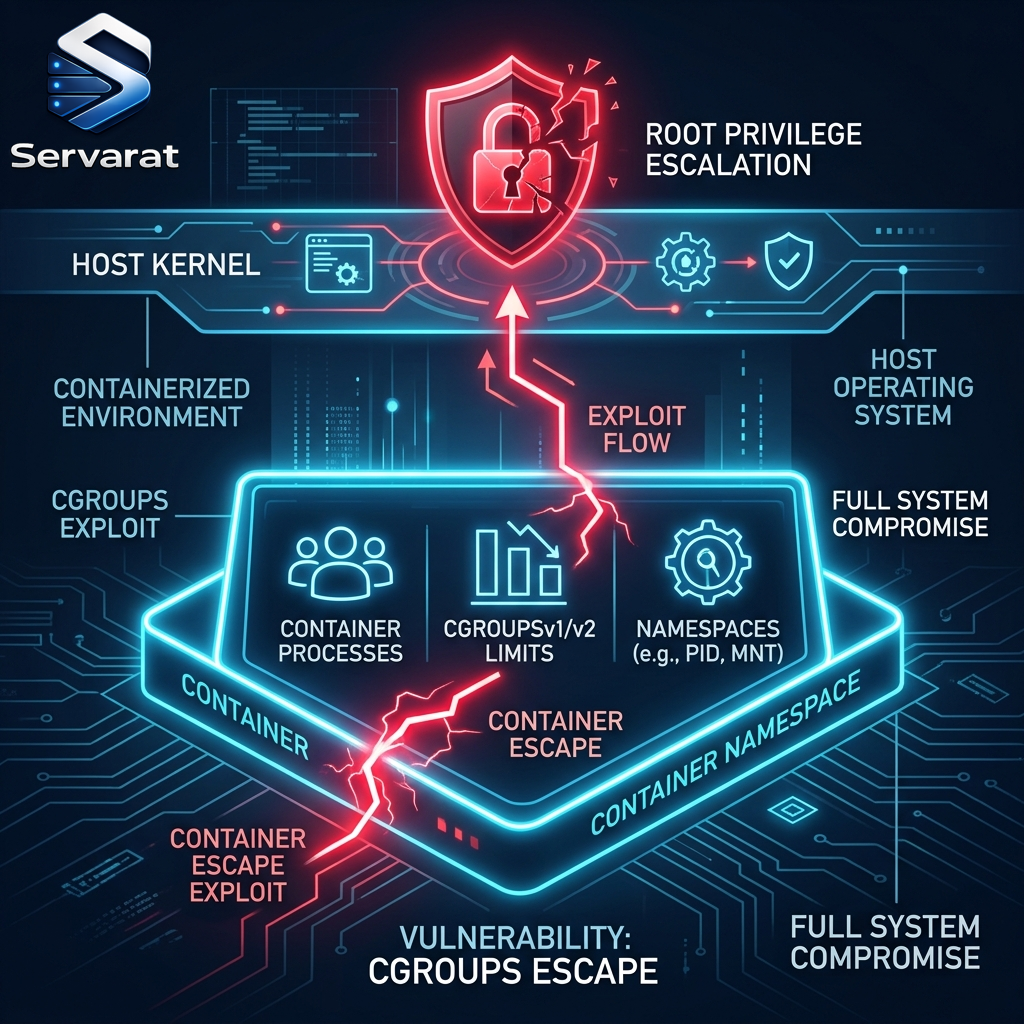
The flaw is in cgroups v1, Linux's resource control and process grouping mechanism. A simple bug in how cgroups validates the release_agent file allows unprivileged users to gain root within containers.
What Cgroups Are (And Why v1 Is the Problem)
Linux cgroups (control groups) let you specify which OS resources a group of processes can use. They're essential for containers—combined with namespaces, cgroups isolate container processes from the host and from each other.
There are two versions:
- Cgroups v2: Modern, unified, more secure
- Cgroups v1: Legacy, fragmented, vulnerable to CVE-2022-0492
Many production systems still use cgroups v1 for compatibility. That's the attack surface.
How the Exploit Works
The vulnerability is straightforward once you understand cgroups internals:
Step 1: The release_agent File
Cgroups v1 has a notification mechanism. When a cgroup becomes empty (all processes exit), cgroups runs a script called release_agent as root within the cgroup's namespace. This is meant for cleanup tasks.
The release_agent file path is stored at the root of the cgroup hierarchy and should only be writable by root. But the vulnerability allows unprivileged users to modify it.
Step 2: Create a Malicious Script
An attacker creates a script on the host filesystem (or mounts one in a container) with arbitrary commands. This script becomes the new release_agent.
Step 3: Trigger the Notification
The attacker creates a cgroup with a malicious release_agent pointing to their script, then empties the cgroup (by killing all processes in it). When the cgroup becomes empty, the kernel executes the release_agent script as root.
Step 4: Container Escape + Root
The script now runs as root on the host. The attacker has escaped the container and gained root privileges.
Bonus exploitation path: The attacker can also create a new user namespace with admin privileges, then create a cgroup with a malicious release_agent file. Same result.
Why This Matters Now
The vulnerability was disclosed three years ago (2023). Technical details have been publicly available. But in-the-wild exploitation wasn't confirmed until this week when Kaspersky reported it in their blog post on container attack vectors.
Key timeline:
- 2023: CVE-2022-0492 disclosure, technical details published
- June 3, 2026: Kaspersky reports in-the-wild exploitation
- June 2, 2026: CISA adds to KEV catalog, urges patching
The fact that a three-year-old vulnerability is suddenly being actively exploited suggests:
- Exploit code became public or weaponized recently
- Attackers are targeting container environments specifically
- This is a known evasion technique in the container attack toolkit
Who's Vulnerable
Direct vulnerability: Any system using cgroups v1 that allows unprivileged user namespace creation.
Container environments: This is the primary attack surface. Containers rely on cgroups for isolation. If cgroups v1 is misconfigured or unpatched, container escape is trivial.
Affected scenarios:
- Kubernetes clusters using cgroups v1 (many do by default)
- Docker with default cgroup driver (cgroups v1 on older systems)
- LXC/LXD containers
- Any application using unshare(1) with cgroup isolation
Not vulnerable:
- Systems using cgroups v2 only
- Systems that disable unprivileged user namespaces
- Systems that restrict cgroup access via SELinux or AppArmor
Patch Status
Kernel fix: Available in recent kernel versions. The issue is in the cgroups v1 code path.
Distribution patches:
- RHEL/CentOS: Available
- Ubuntu: Available
- Debian: Available
- Alpine: Available (if using affected kernel versions)
Check your kernel version:
uname -r
If you're on a kernel released after mid-2022 (after the initial CVE disclosure), you likely have the patch. If not, update immediately.
Immediate Actions
For Container Environments
Option 1: Upgrade to cgroups v2 (recommended, long-term)
Most modern systems support cgroups v2. Switching is the best long-term fix:
# Check if cgroups v2 is available
grep cgroup2 /proc/filesystems

# If present, enable it at boot
# For systemd: add systemd.unified_cgroup_hierarchy=1 to kernel boot parameters
# RHEL/CentOS 9, Ubuntu 22.04+ support this
Option 2: Patch kernel immediately (short-term)
# Debian/Ubuntu
apt update && apt upgrade linux-image-generic
reboot

# RHEL/CentOS/CloudLinux
dnf update kernel
reboot

# Alpine
apk update && apk upgrade linux-virt
reboot
Option 3: Disable unprivileged namespaces (if you don't need containers)
If you're not running containers, disable unprivileged user namespaces:
# RHEL/CentOS
echo 'user.max_user_namespaces = 0' | sudo tee /etc/sysctl.d/99-disable-userns.conf
sudo sysctl -p /etc/sysctl.d/99-disable-userns.conf

# Debian/Ubuntu
echo 'kernel.unprivileged_userns_clone = 0' | sudo tee /etc/sysctl.d/99-disable-userns.conf
sudo sysctl -p /etc/sysctl.d/99-disable-userns.conf
⚠️ This breaks rootless containers and sandboxing. Only use if you don't need those features.
For Kubernetes
If running Kubernetes:
- Patch worker nodes immediately (kernel update + reboot)
- Drain pods during maintenance to avoid disruption
- Monitor for suspicious pod behavior (processes running as root, escaping the pod sandbox)
Kubernetes uses cgroups for resource limits and isolation. Patching is critical.
For Docker/Container Platforms
Ensure:
- Host kernel is patched
- Cgroups v2 is enabled if possible
- SELinux or AppArmor policies restrict cgroup access (defense in depth)
Detection & Monitoring
Signs of exploitation:
- Root processes running outside their containers
- Unexpected code execution in the cgroup namespace
- Modified release_agent files
- Container escape attempts (processes appearing on host from container)
Check for cgroups v1 vulnerabilities:
# Check if cgroups v1 is in use
grep -i cgroup /proc/mounts | head -5

# Output will show either cgroup (v1) or cgroup2 (v2)
# If you see "cgroup " (not cgroup2), you're using v1
Monitor for exploitation:
# Check audit logs for release_agent modifications
grep release_agent /var/log/audit/audit.log

# Check for user namespace creation from containers
grep "namespace" /var/log/audit/audit.log | grep -i "allowed\|denied"
Why Cgroups v1 Still Exists
Cgroups v2 has been available for years and is more secure. But many production systems still use v1 because:
- Compatibility: Older applications and tools expect cgroups v1
- Adoption lag: Kubernetes and container runtimes took years to support v2
- Migration friction: Moving from v1 to v2 requires testing and planning
This is a common pattern in Linux: old, vulnerable code stays around for years because migration is hard.
Real-World Impact
This vulnerability is critical for container environments because:
- Container escape is the goal: Attackers want to break out of containers and reach the host
- Root privileges are the reward: Once escaped, the attacker has full system access
- Three-year latency: A three-year gap between disclosure and active exploitation means many systems remained unpatched thinking the vulnerability "wasn't real"
The fact that Kaspersky is seeing in-the-wild exploitation suggests this is now part of the active threat landscape for container environments.
CISA Timeline
- June 2, 2026: CISA added CVE-2022-0492 to the Known Exploited Vulnerabilities (KEV) catalog
- Federal agencies: Must patch by June 5, 2026 (3 days)
- Everyone else: Should patch immediately (don't wait)
CISA's addition to the KEV catalog signals that this vulnerability is actively weaponized and being used in attacks. Patching is urgent, not optional.
Questions to Ask
- Am I running containers? If yes, you're directly at risk.
- Which cgroups version? Check
grep cgroup /proc/mounts. - Is my kernel patched? Check
uname -ragainst distribution advisories. - Can I upgrade to cgroups v2? This is the best long-term fix.
- Are my container images regularly scanned? Attackers may package exploits in compromised images.