curl 8.21.0 Patches 18 CVEs, Including a 25-Year-Old Bug From 2001

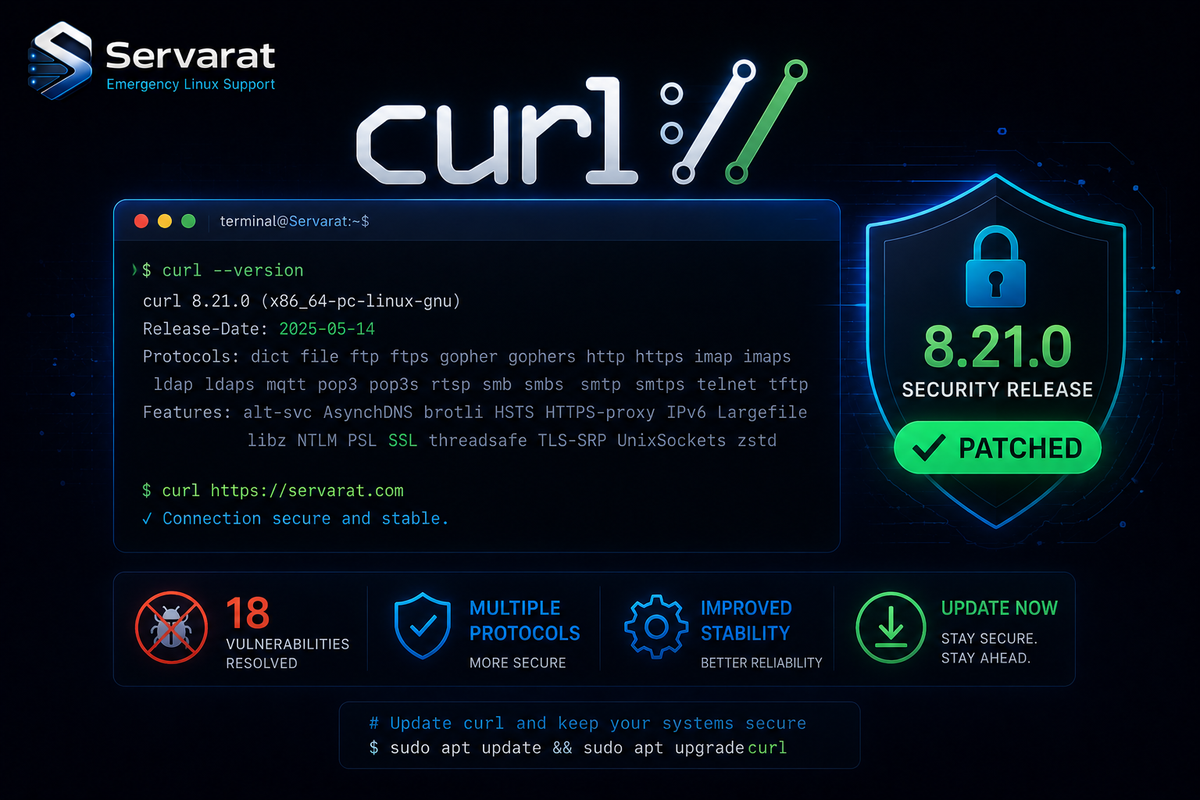
curl 8.21.0 shipped on June 24, 2026 with patches for 18 vulnerabilities — the most CVEs ever fixed in a single curl release, bringing the project's lifetime total to 206. One of the flaws had been sitting in the code for over 25 years.
For a tool running on more than 30 billion devices — servers, phones, cars, embedded systems you've never thought about — a record-breaking security release is worth a closer look. Here's what's in it, where the wave of reports came from, and what actually needs your attention.
The Headliner: A Bug From March 2001
The standout is CVE-2026-8932, the oldest curl vulnerability ever reported. It was introduced in curl 7.7, shipped March 22, 2001, and described as incomplete mTLS config matching in connection reuse — which can lead to authentication bypass.
The mechanism: libcurl keeps previously used connections in a pool so later transfers can reuse them if the setup matches. The bug is that libcurl could reuse an existing connection even after the client certificate or private key settings had changed — settings that should have forced a new connection. In a multi-tenant or multi-identity application, that's an authentication-bypass path: a transfer meant to use one client certificate could ride a pooled connection authenticated with a different one.
⚠️ The detail that determines whether this affects you: CVE-2026-8932 hits libcurl applications, not the curl command-line tool. That's the more dangerous shape, not the less. The command-line tool is visible — you know it's there. libcurl is embedded deep inside products, language bindings, and services where users often have no idea it's present and no direct way to patch it. If you ship or run anything that links libcurl with mTLS and connection pooling, this is yours to track, and the fix is upgrading the bundled libcurl, not running apt upgrade curl on the box.
The Full List
The 18 fixes span the kind of subtle, deep-protocol bugs you'd expect from a codebase this scrutinized. The named CVEs from the release include:
- CVE-2026-8932 — incomplete mTLS config matching in connection reuse (the 2001 bug)
- CVE-2026-9080 — use-after-free after pause in socket callback
- CVE-2026-9545 — exposing HTTP/3 early data
- CVE-2026-9546 — sending an old referer
- CVE-2026-9547 — SSH improper host validation
- CVE-2026-10536 — HTTP/2 stream-dependency tree use-after-free
- CVE-2026-11352 — QUIC zero-length UDP datagrams busy-loop
- CVE-2026-11564 — native CA trust persistence
- CVE-2026-11586 — WebSocket auto-PONG memory exhaustion
- CVE-2026-12064 — protocol default skips SSH verification
The severity spread is four medium and the rest low — no criticals, and importantly, no public reports of in-the-wild exploitation of any curl flaw to date. This is preventive hardening, not active incident response. But "no criticals" doesn't mean "ignore it": several of these are memory-safety bugs (use-after-free, OOB read) and protocol-verification bypasses that matter a great deal in the specific code paths that touch them.
Where the Flood Came From
The interesting backstory: this release record traces directly to AI-assisted vulnerability research. On May 11, 2026, curl founder Daniel Stenberg announced that Anthropic's Mythos model had found a single CVE in curl. That one finding — and the public debate over what it meant — triggered a wave of research and a flood of security reports to the project.
The biggest contributor wasn't a frontier model directly. Vulnerability-management firm AISLE led all organizations with 6 of the 18 CVEs (CVE-2026-8932 included), all reported by Joshua Rogers of its research team, using a model-agnostic AI platform. The next-closest AI-powered organization landed 3; researchers using Anthropic's and OpenAI's models found 1 each. AISLE also generated the fixes for three of the CVEs, not just the findings.
There's a genuinely interesting technical point buried in that result, and it lines up with what the 100-expert letter argued during the Mythos export-control fight: capability here is jagged. For well-defined security tasks like this, smaller, cheaper, locally-runnable models can outperform much larger frontier models — no API calls, no data leaving the network. The takeaway isn't "AI found curl bugs"; it's that the best tool for a narrow security task isn't necessarily the biggest model, and that matters for anyone weighing on-prem vs. API-based security tooling.
Why curl Is Hard to Break Now
It's no accident that Mythos found only one curl bug while a dedicated specialist found six. As AISLE put it, curl is a hard target precisely because the easy bugs are long gone. What remains is the difficult stuff: old protocol paths, state reuse, callback behavior, credential selection, and code paths everyone forgot existed — exactly the category a 25-year-old connection-reuse bug falls into.
That's the shape of mature-codebase security in general. After decades of scrutiny, you're not finding buffer overflows in the obvious places. You're finding logic bugs in how the library decides whether a connection, a credential, or a host identity is still valid — the seams between subsystems, not the subsystems themselves.
What to Actually Do
- Upgrade curl and libcurl to 8.21.0. On the command-line side this is routine package management. The libcurl side is the work.
- Inventory where libcurl is actually embedded. This is the real task and the reason an SBOM earns its keep — libcurl rides inside language bindings (Python's pycurl, PHP, Node native modules), inside vendored binaries, inside appliances and container base images. The
curlyou patch on the host is not the libcurl linked into your application. - Prioritize mTLS users for CVE-2026-8932. If you run libcurl applications doing mutual-TLS with connection pooling and multiple client identities, that's the one to move on first.
- Don't panic-patch. No in-the-wild exploitation, no criticals. Patch on your normal cadence, just don't let the libcurl-embedded copies fall through the cracks the way they usually do.
⚠️ One forward-looking note for planning. The curl project announced a "summer of bliss": it will not accept or process any vulnerability reports from July 1 to August 3, 2026, and the next release (8.22.0) slipped to September 2. The maintainers have been buried under four months of AI-driven report volume and are taking a deliberate break. Practically, that means a roughly five-week window where new curl issues won't be triaged or fixed upstream — so if you depend heavily on curl, this is the stretch to make sure you're current on 8.21.0 rather than waiting on the next round of fixes. The deluge isn't expected to be over; it's just paused.
The Bigger Picture
curl is on track for at least 30 published CVEs in 2026 before the year is half over — a project record by a wide margin, driven almost entirely by AI-assisted research turning up bugs that sat undisturbed for years or decades. None of these vulnerabilities were created by AI. They were always there. The models just compressed the discovery timeline from "maybe never" to "this quarter."
That's the durable lesson, and it echoes the same theme running through the Mythos export-control debate: AI vulnerability discovery doesn't manufacture risk, it surfaces existing risk faster than the patching and inventory processes around it were built to handle. The 25-year-old bug was exploitable for 25 years. The hard part was never the patch — curl shipped that in a day. The hard part is knowing every place libcurl is embedded in your stack so you can actually apply it.